Nyero Rock Paintings, Uganda: History, Ancient Art, Facts and Complete Visitor Guide
Introduction: Discover Uganda’s Ancient Rock Art at Nyero
Hidden among the granite outcrops of eastern Uganda, approximately 8 kilometres west of Kumi town, lies one of the country’s most remarkable archaeological and cultural treasures: Nyero Rock Paintings.
These ancient paintings, created on the sheltered surfaces of enormous granite boulders, provide a fascinating glimpse into the artistic expression, spiritual beliefs and cultural practices of people who inhabited this part of Africa many centuries ago.
The site is famous for its mysterious geometric designs, particularly concentric circles, red and white patterns, elongated shapes, dots and lines. Although researchers have studied the paintings for decades, the exact identity of their creators and the meanings behind many of the symbols remain subjects of archaeological discussion.
Nyero is not simply a collection of prehistoric paintings. It is also a culturally significant landscape associated with the history and traditions of the Iteso people of eastern Uganda.
The rock shelters were historically regarded as sacred places where people made offerings, sought blessings and performed ceremonies connected with rainfall, fertility and protection from misfortune.
Today, Nyero is recognised as one of Uganda’s most important rock art destinations and is included on UNESCO’s Tentative List of World Heritage Sites.
For travellers interested in archaeology, African history, cultural tourism and heritage conservation, a visit to Nyero offers a unique opportunity to explore a fascinating chapter of Uganda’s past.
1. Where Are the Nyero Rock Paintings Located?
Nyero Rock Paintings are located in Nyero, Kumi District, in Uganda’s Teso sub-region, eastern Uganda.
The site lies approximately 8 kilometres west of Kumi town along the Kumi–Ngora road.
It is approximately 200–250 kilometres from Kampala, depending on the route taken.
The archaeological site consists of six principal rock shelters distributed around a series of impressive granite outcrops.
These shelters contain paintings executed mainly in red and white pigments on the inner surfaces and overhangs of the rocks.
The surrounding landscape is characterised by massive granite formations, rolling countryside, scattered vegetation and agricultural settlements.
Location: Nyero, Kumi District, Eastern Uganda.
Nearest town: Kumi.
Distance from Kumi: Approximately 8 kilometres.
Distance from Kampala: Approximately 200–250 kilometres by road.
Heritage status: Gazetted National Cultural Site and Monument.
UNESCO status: Included on the UNESCO World Heritage Tentative List since 1997.
2. History of Nyero Rock Paintings
The history of Nyero Rock Paintings extends far beyond written records of Uganda.
The paintings are archaeological evidence of ancient human activity in eastern Africa and provide important insights into the artistic traditions of communities that occupied the region.
Discovery and documentation in 1913
Nyero Rock Paintings were first formally documented in 1913 in a report associated with the Teso region.
Since then, researchers, archaeologists, historians and cultural heritage specialists have studied the site to understand its origins, artistic techniques and cultural significance.
The paintings attracted particular interest because of their unusual geometric designs, which are also found at other rock art sites across East and Central Africa.
Who painted the Nyero Rock Paintings?
The identity of the artists remains uncertain.
For many years, researchers associated geometric rock art traditions in the region with ancient hunter-gatherer communities, particularly ancestors of the Batwa people.
Other archaeological interpretations have suggested that settled or semi-nomadic communities, including groups involved in livestock keeping, may have created or contributed to some of the paintings.
The British Museum’s African Rock Art project discusses these competing interpretations and highlights the difficulty of establishing the precise authorship of the artwork.
It is therefore important not to present one proposed community as the conclusively established artist of every painting at Nyero.
How old are the paintings?
Dating the paintings is challenging because the pigments were applied directly to exposed rock surfaces, making conventional archaeological dating difficult.
Some estimates suggest that the paintings may be several thousand years old.
Radiocarbon research associated with Nyero and Kakoro has produced dates ranging approximately from 5,000 to 1,600 years ago.
Other archaeological descriptions place the sites within a broader prehistoric and later Iron Age cultural context.
The precise age of individual paintings is not conclusively established, and different studies use different chronological interpretations.
3. What Makes Nyero Rock Paintings Special?
Nyero is particularly famous for its geometric rock art.
Unlike some African rock art sites that feature detailed human and animal figures, Nyero’s paintings are dominated by abstract designs.
The artwork was created using mineral-based pigments, primarily red and white.
Some of the most recognisable designs include:
-
Concentric circles.
-
Circles with radiating lines.
-
Elongated oval shapes.
-
Acacia-pod-like figures.
-
Canoe-shaped motifs.
-
Dots and parallel lines.
-
Curved and rectangular patterns.
-
Interconnected geometric designs.
The repeated use of concentric circles is particularly interesting because similar artistic traditions appear at other archaeological sites across the Lake Victoria region.
Researchers have proposed different explanations for these patterns, including symbolic, spiritual, environmental and cultural interpretations.
However, the exact meanings of many individual designs remain unknown.
The significance of concentric circles
Concentric circles are among the most distinctive features of Ugandan rock art.
At Nyero, some paintings contain several circles arranged around a central point, sometimes surrounded by additional curved or radiating lines.
These designs have attracted interest from archaeologists because of their complexity and repetition.
Some interpretations connect geometric artwork with spiritual beliefs and the relationship between ancient communities and their natural environment.
Nevertheless, there is no universally accepted explanation for every symbol.
The mystery surrounding the artwork is part of what makes Nyero such an interesting archaeological destination.
4. Exploring the Six Rock Shelters at Nyero
The Nyero archaeological complex contains six principal rock art shelters, identified as Nyero 1, Nyero 2, Nyero 3, Nyero 4, Nyero 5 and Nyero 6.
Each shelter contains different paintings, patterns and physical characteristics.
Exploring these shelters is the main attraction for visitors.
4.1 Nyero 1: White Concentric Circles
Nyero 1 is a relatively small rock shelter located near the outer edge of the granite outcrop.
It is particularly famous for its white geometric paintings.
The artwork includes approximately six sets of concentric circles and a distinctive design commonly described as resembling an acacia pod.
The paintings are located beneath an overhanging rock surface.
Nyero 1 is interesting because of the simplicity and symmetry of its geometric designs.
For visitors, it provides an introduction to the artistic traditions represented throughout the Nyero complex.
4.2 Nyero 2: The Main Rock Art Shelter
Nyero 2 is the most prominent and extensively documented shelter within the complex.
It contains the largest and most impressive collection of paintings at the site.
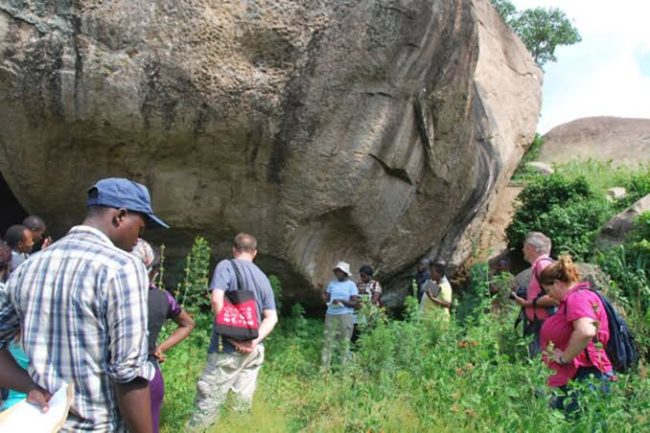
The shelter is formed beneath an enormous granite boulder that broke away from the surrounding rock formation.
The British Museum’s African Rock Art documentation estimates that this boulder weighs at least 20,000 tonnes.
A vertical rock surface at the back of the shelter measures approximately 10 metres in height.
The paintings are mainly red and include more than 40 identified designs.
The most recognisable features include:
-
Concentric circles.
-
Elongated sausage-shaped designs.
-
Canoe-like shapes.
-
Parallel lines.
-
Dots and other geometric patterns.
-
Overlapping and superimposed artwork.
One of the most interesting features is a large design often described as a canoe because of its elongated shape.
Researchers have also documented a small area associated with traditional offerings.
The large overhanging boulder provides natural protection from direct rainfall and sunlight, helping preserve some of the paintings.
Nyero 2 is particularly important for understanding the artistic complexity and archaeological significance of the entire site.
4.3 Nyero 3: The Distinctive White Circular Designs
Nyero 3 is located approximately eight minutes’ walk from Nyero 2.
The shelter is formed by a large boulder resting on supporting rocks.
Its most distinctive paintings are white concentric circles surrounded by curved and linear designs.
Some of the patterns contain multiple circular bands with additional lines and compartments.
The shelter is especially interesting because of the elaborate nature of its artwork.
One of the famous white circular designs from Nyero 3 has also been adopted as the logo of the Uganda Museum.
This demonstrates the importance of Nyero in Uganda’s national cultural heritage.
4.4 Nyero 4: Faint Red Geometric Paintings
Nyero 4 is a smaller shelter located on the southwestern side of the hill.
Its paintings are relatively faint compared with those found at Nyero 1 and Nyero 2.
The surviving designs include traces of red concentric circles, conical shapes and lines.
Although less visually prominent, Nyero 4 contributes to the wider archaeological significance of the complex.
4.5 Nyero 5: Red Geometric Artwork
Nyero 5 is situated on the western side of the hill.
The shelter contains red geometric paintings made using both finger application and brush-like techniques.
Its designs include circular and linear shapes arranged in different combinations.
Unfortunately, the artwork has experienced considerable natural deterioration.
Water erosion has made some paintings difficult to distinguish.
Despite this damage, Nyero 5 remains important for understanding the diversity of painting techniques used across the site.
4.6 Nyero 6: Paintings at the Top of the Hill
Nyero 6 is situated near the top of the granite hill.
Unlike the other shelters, it is particularly exposed to rainfall and morning sunlight.
The surviving artwork includes:
-
Two small oval outlines.
-
A slanting L-shaped design.
-
An outlined cross-like shape.
-
A small circular marking.
The paintings are made using red pigment applied with the fingers.
Unfortunately, the painted rock surface has experienced exfoliation, meaning that parts of the outer rock layers are peeling away.
Nyero 6 is nevertheless an interesting part of the archaeological complex because of its location and the surviving evidence of ancient artistic activity.
5. What Do the Nyero Rock Paintings Mean?
One of the greatest mysteries surrounding Nyero is the meaning of its paintings.
Although researchers have documented the designs, their original meanings have not been conclusively established.
Several interpretations have been proposed.
Spiritual and religious symbolism
Some researchers believe the paintings were associated with spiritual beliefs and ritual activities.
The rock shelters were historically regarded as sacred places by local communities, where people made offerings and sought assistance from ancestral spirits.
Rainmaking ceremonies
Oral traditions associate Nyero with ceremonies intended to bring rainfall.
In communities whose livelihoods depended heavily on agriculture, rainfall was essential for crop production and survival.
The shelters therefore had significance beyond their artistic appearance.
Fertility and childbirth
Some historical accounts describe the use of the shelters by people seeking blessings related to childbirth and fertility.
Nyero 3, in particular, has been associated with fertility-related beliefs.
Ancestral worship and traditional offerings
The shelters were traditionally associated with offerings of food, beer, money and other items.
People reportedly visited the sites during periods of drought, misfortune and other difficulties.
These traditions demonstrate that Nyero has remained culturally significant long after the original paintings were created.
Importantly, the spiritual interpretations come from archaeological research and local oral histories; the original meaning of every geometric symbol remains uncertain.
6. The Iteso People and the Cultural Significance of Nyero
Nyero is located within the traditional homeland of the Iteso people, one of Uganda’s major ethnic communities.
The Iteso are primarily found in the Teso sub-region, which includes districts such as Kumi, Soroti, Ngora, Bukedea, Amuria and Katakwi.
Their cultural heritage is closely associated with agriculture, livestock keeping, traditional leadership, music, dance and community celebrations.
Nyero and traditional beliefs
For generations, the Nyero shelters have been associated with spiritual practices and ancestral traditions.
Local oral histories describe people travelling from surrounding communities to make offerings and seek blessings.
The paintings therefore have significance beyond their archaeological value.
They represent a connection between the landscape, historical memory and the spiritual traditions of the communities living around the site.
Cultural identity and heritage preservation
Nyero is an important part of eastern Uganda’s cultural identity.
Preserving the paintings helps protect the history of the region and provides opportunities for younger generations to learn about their ancestors and traditional practices.
Visitors can learn more about Iteso history and culture by combining a visit to Nyero with cultural experiences in Kumi and other parts of Teso.
7. Things to Do at Nyero Rock Paintings
Nyero offers more than an opportunity to look at ancient paintings. The site combines archaeology, landscape exploration, cultural history and educational tourism.
Here are some of the experiences visitors can enjoy.
7.1 Explore the Ancient Rock Paintings
The main reason to visit Nyero is to explore the six rock shelters and observe their ancient paintings.
Walking between the shelters allows visitors to appreciate the differences in artistic designs, colours and painting techniques.
Nyero 1, Nyero 2 and Nyero 3 are particularly interesting because of their distinctive geometric patterns.
A knowledgeable local guide can explain the archaeological history, cultural traditions and different interpretations of the paintings.
7.2 Discover the Granite Rock Formations
The enormous granite boulders surrounding the paintings are an attraction in their own right.
Their unusual formations create natural shelters, narrow passages, overhangs and interesting rock landscapes.
Visitors can appreciate how ancient communities used these natural formations as sheltered spaces for artistic and possibly ritual activities.
7.3 Learn About Ancient African Art
Nyero provides an opportunity to learn about prehistoric African artistic traditions.
Visitors can study the use of geometric shapes, natural pigments and different painting techniques.
The site is especially interesting for students, archaeologists, historians and travellers interested in understanding the development of early human artistic expression.
7.4 Photography
The ancient paintings and surrounding granite landscape create interesting photographic subjects.
Visitors can photograph the rock formations, shelters and surrounding countryside.
Close-up photography of the paintings can reveal details that may not be immediately visible to the naked eye.
However, visitors should avoid touching the painted surfaces or using flash and other equipment in ways that could damage the artwork.
Always follow site photography instructions.
7.5 Cultural Heritage Tours
A guided cultural experience can help visitors understand the relationship between Nyero and the traditions of the Iteso people.
Depending on local arrangements, visitors can learn about traditional ceremonies, community history, agriculture, food and cultural performances.
These experiences can provide a more complete understanding of eastern Uganda beyond the archaeological site.
7.6 Educational and Research Visits
Nyero is an excellent destination for educational visits.
Schools, universities, archaeological researchers and cultural heritage organisations can use the site to study:
-
Prehistoric art and archaeology.
-
African cultural heritage.
-
Ancient painting techniques.
-
Traditional spiritual beliefs.
-
Heritage conservation.
-
The relationship between communities and landscapes.
8. UNESCO World Heritage Status: Is Nyero a UNESCO World Heritage Site?
Nyero is included on UNESCO’s World Heritage Tentative List under the title:
Nyero and Other Hunter-Gatherer Geometric Rock Art Sites in Eastern Uganda.
Uganda submitted the property to the UNESCO Tentative List on 10 September 1997.
This is an important distinction: Nyero is not currently an inscribed UNESCO World Heritage Site.
The tentative listing identifies cultural properties that a country considers suitable for possible future nomination to the World Heritage List.
The wider proposed heritage property includes several rock art locations in eastern Uganda, not just Nyero.
These include:
-
Nyero.
-
Kakoro.
-
Komuge.
-
Mukongoro.
-
Kapir.
-
Dolwe Island.
The sites demonstrate a wider tradition of geometric rock art associated with ancient communities in the Lake Victoria region.
Why does UNESCO recognise Nyero’s importance?
The significance of the site includes:
-
Its archaeological evidence of ancient human artistic expression.
-
Its distinctive geometric painting traditions.
-
Its connection to the spiritual and cultural history of eastern Uganda.
-
Its relationship with other prehistoric rock art sites in the region.
-
Its importance for understanding ancient African societies.
The UNESCO designation provides international recognition of the site’s cultural value and the importance of protecting it.
9. Conservation Challenges Facing Nyero Rock Paintings
Despite their historical importance, the paintings face several conservation challenges.
Because the artwork was created on exposed rock surfaces, it is vulnerable to environmental conditions and human activities.
Natural weathering and water erosion
Rainfall and changes in temperature gradually affect the rock surfaces.
At Nyero 5, water erosion has damaged or obscured some paintings.
At Nyero 6, exposure to rain and sunlight has contributed to the deterioration of the painted surface.
Mineral deposits
At Nyero 2, some paintings are affected by mineral salts leaching from the rock.
These deposits can cover parts of the artwork and make the original designs difficult to see.
Human activities
Rock quarrying, deforestation, uncontrolled burning and other land-use activities around the site can threaten the archaeological landscape.
The Heritage Management Organization has documented conservation initiatives addressing quarrying, deforestation and soil erosion around Nyero.
Visitor-related damage
Touching the paintings, scratching the rocks, writing on surfaces and leaving litter can contribute to the deterioration of the site.
Responsible tourism is essential to ensure that future generations can continue enjoying this important heritage.
Community participation
Conservation requires cooperation between government institutions, local communities, cultural organisations, researchers and tourism operators.
Local communities are especially important because they have historical connections to the site and can contribute to its protection.
10. Best Time to Visit Nyero Rock Paintings
Nyero can be visited throughout the year, but weather conditions can influence the comfort of walking between the shelters.
Eastern Uganda generally experiences two wetter periods, although rainfall patterns vary.
June to August
This period is often suitable for exploring eastern Uganda, with relatively favourable conditions for outdoor activities in many years.
Visitors can enjoy walking around the granite formations and exploring the shelters.
December to February
These months are also generally suitable for cultural and heritage excursions.
The countryside may be drier, and walking around the archaeological complex can be more comfortable.
March to May and September to November
These periods can experience increased rainfall.
The surrounding vegetation may be greener, creating attractive scenery, but wet surfaces can make some rocky sections slippery.
Our recommendation: Plan your visit during a relatively dry period and allow sufficient time to explore all six shelters with a guide.
11. How to Get to Nyero Rock Paintings
Nyero Rock Paintings can be accessed by road from Kampala, Mbale, Soroti and other towns in eastern Uganda.
From Kampala
The journey from Kampala is approximately 200–250 kilometres, depending on the route.
A common route follows:
Kampala – Jinja – Iganga – Tirinyi – Mbale – Kumi – Nyero.
The journey generally takes approximately 4–6 hours, depending on traffic, road conditions and stops.
From Mbale
Visitors travelling from Mbale can follow the road towards Kumi through the eastern Uganda countryside.
The journey is approximately 80–100 kilometres, depending on the route.
From Soroti
Soroti is another convenient starting point for exploring Nyero.
The journey to Kumi and onward to the rock paintings is relatively short compared with travelling from Kampala.
From Kumi town
Nyero is approximately 8 kilometres west of Kumi town along the Kumi–Ngora road.
Visitors can use a private vehicle, taxi or locally arranged transport to reach the site.
12. What to Expect During a Visit
A visit to Nyero is generally a walking and heritage experience rather than a conventional wildlife safari.
Visitors should expect:
-
A guided introduction to the history of the site.
-
Walking between granite shelters.
-
Viewing ancient red and white geometric paintings.
-
Learning about traditional beliefs and cultural practices.
-
Exploring impressive granite rock formations.
-
Opportunities for photography and archaeological learning.
The amount of time needed depends on how many shelters you explore and how much time you spend learning about their history.
Allow approximately 1–2 hours for a general visit, with additional time for a more detailed guided experience.
13. Where to Stay When Visiting Nyero
Visitors can stay in Kumi, Soroti or Mbale, depending on their wider travel itinerary and accommodation preferences.
Kumi: The most convenient option for visitors who want to explore Nyero without travelling long distances on the day of their visit. Accommodation options are relatively limited.
Soroti: A practical alternative for travellers exploring the Teso region. The town has additional accommodation and restaurant facilities.
Mbale: A good option for visitors combining Nyero with Sipi Falls, Mount Elgon and other eastern Uganda attractions.
For travellers seeking higher-end accommodation, it is advisable to research and confirm suitable facilities in advance.
14. Other Places to Visit Near Nyero Rock Paintings
Nyero can be combined with other attractions in eastern and northeastern Uganda.
This is an excellent way to create a more comprehensive cultural and nature itinerary.
14.1 Sipi Falls
Located on the slopes of Mount Elgon, Sipi Falls is one of Uganda’s most beautiful waterfall destinations.
The attraction consists of three main waterfalls, surrounded by green hills, coffee farms and scenic countryside.
Activities include:
-
Waterfall hiking.
-
Coffee tours.
-
Nature walks.
-
Photography.
-
Community visits.
-
Cultural experiences.
Sipi Falls is an excellent addition to a longer eastern Uganda itinerary.
14.2 Mount Elgon National Park
Mount Elgon is an extinct volcanic mountain located along the Uganda–Kenya border.
The Ugandan side is protected as Mount Elgon National Park.
It is famous for its extensive mountain forests, waterfalls, caves, unique vegetation and hiking opportunities.
The mountain’s highest point, Wagagai Peak, reaches approximately 4,321 metres above sea level.
14.3 Pian Upe Wildlife Reserve
Pian Upe Wildlife Reserve is one of Uganda’s largest protected wildlife areas.
Located in northeastern Uganda, it is famous for its open savanna landscapes, mountain scenery and wildlife.
Visitors can look for:
-
Zebras.
-
Elands.
-
Ostriches.
-
Giraffes.
-
Antelopes.
-
Cheetahs, although sightings are rare.
Pian Upe offers a different experience from the traditional western Uganda safari circuit.
14.4 Lake Kyoga
Lake Kyoga is a large shallow lake located in central Uganda.
Its surrounding wetlands support important bird habitats and local fishing communities.
Visitors interested in wetland ecology, fishing traditions and birdwatching can consider including the lake in a broader eastern Uganda journey.
14.5 Nyero and Kakoro Rock Art Sites
For travellers interested in archaeology, exploring additional rock art locations in eastern Uganda provides a deeper understanding of the region’s ancient artistic traditions.
Kakoro is another important geometric rock art site associated with the wider eastern Uganda rock art heritage.
Combining Nyero and Kakoro can provide a more comprehensive experience of prehistoric art in the region.
15. Entrance Fees and Visitor Information
Nyero is a gazetted national cultural site and monument.
Visitors should confirm the current entrance fees, guiding charges and opening arrangements with the site management or the relevant heritage authorities before travelling.
For visitor planning, establish:
-
Applicable foreign visitor and East African citizen rates.
-
Whether a local guide is included.
-
Photography requirements.
-
Group and educational visit arrangements.
-
Any restrictions on accessing particular shelters.
16. Essential Travel Tips for Visiting Nyero
-
Wear comfortable walking shoes with good grip.
-
Carry drinking water, especially during hot weather.
-
Hire an authorised or knowledgeable local guide.
-
Bring a camera for the rock formations and landscape.
-
Avoid touching, scratching or marking the paintings.
-
Do not apply water, chalk or other substances to the artwork.
-
Respect local cultural traditions and sacred areas.
-
Carry sun protection, including a hat and sunscreen.
-
Avoid climbing unstable boulders.
-
Allow enough time to explore all six shelters.
17. Frequently Asked Questions About Nyero Rock Paintings
1. Where are Nyero Rock Paintings found?
They are located in Nyero, Kumi District, eastern Uganda, approximately 8 kilometres west of Kumi town.
2. How old are Nyero Rock Paintings?
Their exact age is uncertain. Radiocarbon research associated with Nyero and Kakoro suggests dates ranging approximately from 5,000 to 1,600 years ago. Different studies offer different interpretations.
3. Who painted the Nyero Rock Paintings?
Their creators have not been conclusively identified. Some researchers associate the art with ancestral Batwa hunter-gatherer communities, while other interpretations consider settled and semi-nomadic communities.
4. How many rock shelters are found at Nyero?
There are six principal shelters: Nyero 1, Nyero 2, Nyero 3, Nyero 4, Nyero 5 and Nyero 6.
5. What are the paintings made of?
They were created using mineral-based pigments, mainly red and white, applied to granite rock surfaces.
6. What do the concentric circles mean?
Their exact meaning is unknown. Researchers have proposed spiritual, symbolic and cultural interpretations, but there is no universally accepted explanation.
7. Why is Nyero 2 famous?
Nyero 2 contains the largest and most extensively documented collection of paintings in the complex, including more than 40 identified designs.
8. Is Nyero a UNESCO World Heritage Site?
It is on UNESCO’s Tentative List, having been submitted in 1997. It is not currently an inscribed UNESCO World Heritage Site.
9. What is the connection between Nyero and the Iteso people?
Nyero lies in the Teso region and is associated with Iteso oral traditions, spiritual practices and cultural heritage.
10. How long does it take to visit Nyero?
Approximately 1–2 hours is a reasonable allowance for a general visit. More time may be required for detailed exploration of all six shelters.
11. Can Nyero be visited from Kampala in one day?
Yes, it is possible, but it involves a substantial road journey. An overnight stay in Kumi, Soroti or Mbale makes the experience more comfortable.
12. What other attractions can be combined with Nyero?
Visitors can combine Nyero with Sipi Falls, Mount Elgon National Park, Pian Upe Wildlife Reserve, Kakoro Rock Art Site and other eastern Uganda attractions.
13. Why should tourists visit Nyero?
Nyero offers a rare opportunity to explore ancient African rock art, understand traditional beliefs and discover an important part of Uganda’s archaeological and cultural heritage.
18. Explore Uganda’s Cultural Heritage with Epic Uganda Vacation
Uganda is more than a destination for gorilla trekking, wildlife safaris and mountain adventures. Its cultural and archaeological heritage reveals fascinating stories about the people who inhabited the region long before modern tourism developed.
At Epic Uganda Vacation, we believe that exploring Uganda should go beyond visiting famous national parks.
We organise tailor-made journeys that connect travellers with Uganda’s natural landscapes, cultural traditions, historical landmarks and local communities.
A visit to Nyero Rock Paintings can be incorporated into an eastern Uganda cultural journey featuring Kumi, Soroti, Sipi Falls, Mount Elgon and other regional attractions.
Whether you are interested in archaeology, history, photography, cultural experiences or exploring lesser-known destinations, we can help you design an itinerary around your interests.
Discover Uganda’s history, culture and natural beauty with Epic Uganda Vacation.
Visit www.epicugandavacation.com to start planning your journey.