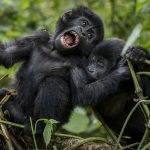
Kwita Izina is Rwanda’s annual gorilla naming ceremony and one of the country’s most important celebrations of wildlife conservation, culture and sustainable tourism. Held in Kinigi at, in the foothills of Volcanoes National Park in northern Rwanda, the event brings together conservationists, researchers, rangers, veterinarians, tourism professionals, community representatives, government officials, the foothills of Volcanoes National Park in northern Rwanda, the event brings together conservationists, researchers, rangers, veterinarians, tourism professionals, community representatives, government officials and international guests to celebrate newborn mountain gorillas and the people dedicated to protecting them.
The name Kwita Izina comes from the Kinyarwanda phrase meaning “to give a name.” The ceremony is inspired by a traditional Rwandan cultural practice in which a newborn child is introduced and given a name in the presence of family, friends and members of the wider community. Rwanda adapted this tradition to conservation by using it to name newborn mountain gorillas.
Since the first official Kwita Izina ceremony in 2005, the event has grown from a national conservation celebration into an internationally recognized platform for discussing mountain gorilla protection, biodiversity, tourism and community development. Every year, newly born gorillas are given names, while the event also recognizes the rangers, trackers, researchers, veterinarians, communities and conservation partners whose work helps protect the species.
Gorilla Namers of 2026

For travelers, Kwita Izina offers an opportunity to experience another side of Rwanda’s famous gorilla story. A gorilla trek allows visitors to enter the forest and spend time near a habituated gorilla family. Kwita Izina provides the broader picture. It shows the conservation work, cultural traditions, community involvement and scientific research that make the protection of mountain gorillas possible.
The 2026 edition of Kwita Izina, the 21st ceremony, was held on 4 September 2026 in Kinigi, Musanze District. Twenty-two baby mountain gorillas were named under the theme “Conservation is Life: Sustaining the Future.” The ceremony continued a tradition that has now connected more than two decades of gorilla conservation with Rwanda’s culture and tourism industry.
What Is Kwita Izina?
Kwita Izina is Rwanda’s annual Gorilla Naming Ceremony, an event dedicated to celebrating newborn mountain gorillas and the wider conservation efforts that protect them.
At the center of the ceremony is the naming of young gorillas born within the mountain gorilla population. However, the ceremony is much more than the simple act of giving an animal a name. It has become an important platform for communicating Rwanda’s conservation achievements and the challenges that remain in protecting one of the world’s most endangered great apes.
The ceremony brings together people from different parts of the conservation sector. Rangers who spend their days protecting the national park, trackers who follow gorilla families through the forest, researchers who study their behavior and population dynamics, and veterinarians who monitor their health all form part of the larger story.
Community members are also an important part of Kwita Izina because conservation does not take place in isolation. Volcanoes National Park is surrounded by communities whose livelihoods and daily lives are connected to the landscape. Sustainable conservation therefore requires cooperation between protected-area authorities and the people living around the park.
Kwita Izina also provides an opportunity for Rwanda to demonstrate how tourism can contribute to conservation. Mountain gorilla tourism has become an important part of Rwanda’s tourism economy, while revenue generated by protected-area tourism supports conservation and community development initiatives. The ceremony therefore represents several things at once: a cultural tradition, a wildlife celebration, a conservation event, a tourism platform and a community-focused initiative.
What Does Kwita Izina Mean?
The phrase Kwita Izina means “to give a name” in Kinyarwanda. Naming has an important place in Rwandan culture. Traditionally, the naming of a newborn is not simply an administrative exercise. It is a meaningful occasion that connects the child to family, community and cultural identity. Rwanda incorporated this tradition into gorilla conservation because individual identification is also important in the scientific monitoring of mountain gorillas.
Researchers and trackers need to distinguish individual gorillas from one another. Mountain gorillas live in complex social groups, and individual animals have recognizable characteristics, relationships and histories. Giving each animal a name makes it easier for researchers, rangers and conservation teams to maintain long-term records.
The cultural meaning of naming and the scientific importance of identifying individual gorillas therefore come together through Kwita Izina. A gorilla receives a name, but that name can also become part of the animal’s conservation history.
The History of Kwita Izina
The modern Kwita Izina ceremony began in 2005, but the practice of naming individual gorillas existed before the public ceremony was established.
Researchers and conservation workers have long needed to identify individual mountain gorillas. Each animal has different physical characteristics, social relationships and behavioral patterns. Names make long-term monitoring more practical and allow researchers and trackers to build detailed records about individual animals and their families. The creation of Kwita Izina transformed this practical conservation practice into a public celebration.
The first ceremony established a tradition that has continued annually. Over time, the event attracted increasing international attention, with conservationists, tourism professionals, public figures, athletes, artists, business leaders and other influential guests taking part.
As the event developed, its purpose expanded beyond naming gorillas. Kwita Izina became a platform for discussing the wider conservation landscape, including habitat protection, community development, tourism revenue, scientific research and international cooperation. The ceremony has therefore evolved alongside Rwanda’s conservation program. What began as a celebration of newborn gorillas has become an annual reminder that the survival of mountain gorillas depends on an entire network of people, institutions and communities.
First Kwita Izina Ceremony in 2005
The first official Kwita Izina ceremony in 2005 established what would become one of Rwanda’s most recognizable conservation traditions. The decision to use a traditional Rwandan naming practice for gorillas created a strong connection between wildlife conservation and local culture.
Rather than treating conservation as something separate from Rwandan society, the ceremony presented mountain gorillas as part of a national story. Over the years, the event became increasingly prominent. More conservation partners became involved, international visitors began attending, and the ceremony developed into a major annual gathering. The growth of Kwita Izina reflects the growing international interest in mountain gorilla conservation. Today, the ceremony is recognized not only for the gorillas being named but also for the people and organizations being recognized for their contribution to conservation.
Why Are Baby Gorillas Given Names?
There are both practical and symbolic reasons for naming baby gorillas. From a scientific perspective, individual identification is essential for monitoring a population over time. Researchers need to know which gorillas belong to which families, who their mothers are, how they develop and how they interact with other members of their social group.
A name provides an easy way to identify an individual. The name can be connected to information about the gorilla’s birth, family, social group, physical development, behavior and health. This becomes particularly important when researchers monitor gorillas for many years. From a public perspective, names make conservation easier to understand.
It is one thing to hear that the mountain gorilla population is increasing. It is another to hear the story of a particular newborn gorilla, learn its name and understand the family into which it was born. Giving gorillas names therefore creates an emotional connection between people and wildlife while also supporting practical conservation monitoring.
Where Is Kwita Izina Held?
Kwita Izina is held in Kinigi, in Musanze District in northern Rwanda. Kinigi lies close to the foothills of Volcanoes National Park, one of Rwanda’s most important protected areas and the home of the country’s mountain gorilla population. The landscape surrounding Kinigi is dominated by the dramatic Virunga volcanoes. This region is green, mountainous and characterized by high-altitude forests, farmland and volcanic peaks. The location is particularly appropriate for the ceremony because it places the celebration directly within the landscape associated with Rwanda’s mountain gorilla conservation efforts.
Travelers arriving from Kigali generally travel north toward Musanze before continuing to Kinigi. Musanze serves as an important base for visitors exploring Volcanoes National Park and the surrounding region.
Map of Kigali, Musanze, Kinigi and Volcanoes National Park
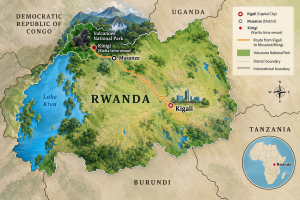
The route from Kigali to the Kwita Izina venue is relatively straightforward. Travelers normally leave Kigali and travel north toward Musanze, before continuing toward Kinigi and the entrance area of Volcanoes National Park.
The region’s geography is important to understanding the gorilla conservation story. Volcanoes National Park forms part of the larger Virunga landscape, which extends across Rwanda, Uganda and the Democratic Republic of the Congo.
Volcanoes National Park and Kwita Izina
Volcanoes National Park is at the heart of Rwanda’s mountain gorilla conservation story. The park protects part of the Virunga volcanic mountain range and provides habitat for mountain gorillas, golden monkeys, birds and numerous other species. The landscape is dominated by volcanic mountains, including Mount Karisimbi, Mount Bisoke, Mount Sabyinyo, Mount Gahinga and Mount Muhabura.
Mount Karisimbi is the highest of these volcanoes, reaching approximately 4,507 metres above sea level. The mountains create a distinctive environment of forests, bamboo, grasslands, wetlands and high-altitude vegetation.
This landscape is not only beautiful for visitors. It is essential habitat for wildlife. The location of Kwita Izina at the edge of this protected landscape reinforces the connection between the ceremony and the natural environment it celebrates.
How Far Is Kinigi From Kigali?
Kigali is the main gateway for most international visitors arriving in Rwanda. From Kigali, travelers can drive north toward Musanze and then continue to Kinigi. The journey takes several hours by road, depending on the starting point, traffic, road conditions and stops along the way.
The route itself can be an enjoyable part of a Rwanda itinerary because the landscape changes considerably as travelers leave the capital and move toward the northern highlands. A visitor attending Kwita Izina can therefore combine the ceremony with time in Kigali and other activities around Musanze and Volcanoes National Park.
Kwita Izina 2026
The 21st Kwita Izina took place on 4 September 2026 in Kinigi. The official theme for the 2026 ceremony was: “Conservation is Life: Sustaining the Future.” Twenty-two baby mountain gorillas were named during the ceremony. The event continued the tradition established in 2005 and highlighted the connection between biodiversity conservation, community development, tourism and the long-term protection of Rwanda’s natural heritage.
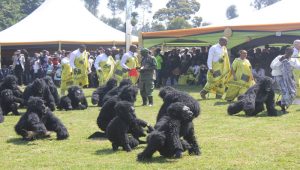
The 2026 edition also reflected the increasing importance of habitat protection as the mountain gorilla population continues to recover. The ceremony was therefore not simply a celebration of individual newborn gorillas. It was also a platform for discussing how Rwanda can protect mountain gorillas and their ecosystem for future generations.
Kwita Izina 2025
The 20th Kwita Izina ceremony took place on 5 September 2025. Forty baby mountain gorillas were named during the event. The 2025 ceremony was particularly significant because it marked two decades since the first official Kwita Izina in 2005. The event recognized conservationists, rangers, researchers, veterinary professionals, tourism stakeholders, community representatives and international partners.It demonstrated how the ceremony had grown from a relatively simple naming tradition into a major international conservation event.
Kwita Izina 2025 and 2026 at a Glance
| Feature | Kwita Izina 2025 | Kwita Izina 2026 |
|---|---|---|
| Edition | 20th | 21st |
| Date | 5 September 2025 | 4 September 2026 |
| Location | Kinigi, Musanze | Kinigi, Musanze |
| Baby gorillas named | 40 | 22 |
| Main focus | Gorilla conservation and community development | Conservation and long-term sustainability |
| Theme | Conservation and sustainable development | Conservation is Life: Sustaining the Future |
The number of gorillas named changes every year because the ceremony reflects births within the population during the relevant period.
Who Names the Gorillas?
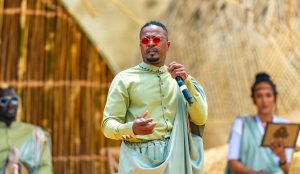
The people selected to name the gorillas are often referred to as Namers. They come from a wide range of backgrounds. Some are directly involved in conservation, while others have supported Rwanda’s tourism, environmental or community development efforts. Namers have included conservationists, researchers, rangers, veterinarians, government representatives, philanthropists, artists, athletes, business leaders and international public figures.
The selection of Namers gives Rwanda an opportunity to recognize people who have contributed to conservation or who can help communicate the importance of protecting biodiversity.
However, one of the most meaningful aspects of the ceremony is the recognition of people who work directly with the animals. A ranger or tracker who spends years following gorilla families through the forest has a very different relationship with these animals from a visitor who sees a gorilla for the first time. Kwita Izina provides an opportunity to recognize that expertise and dedication.
What Happens During the Kwita Izina Ceremony?
This program changes from one edition to another, but Kwita Izina generally combines cultural performances, conservation presentations, speeches, recognition of conservation workers and the naming of the newborn gorillas. The atmosphere is both ceremonial and celebratory. Guests gather at the venue in Kinigi, where they can listen to presentations about conservation and watch cultural performances representing Rwanda’s heritage.
The Namers are introduced and each takes part in giving a name to one of the newborn gorillas. The meaning behind each name is often explained, adding another layer to the ceremony. This event also provides an opportunity to recognize the people who work behind the scenes. Rangers, trackers, researchers and veterinary teams are an essential part of the mountain gorilla conservation system, and their work is frequently highlighted during the ceremony.
What Do the Gorilla Names Mean?
The names selected during Kwita Izina often carry meaningful messages. They may refer to qualities such as strength, courage, unity, hope, resilience, connection, gratitude or sustainability. In some cases, the name reflects an important event, relationship or characteristic associated with the gorilla or the wider conservation story.
During the 2026 ceremony, for example, names included Ishakwe, associated with determination; Mukondo, referring to a starting point or source; Shikama, conveying the idea of standing strong; and Muhuza, meaning one who connects or brings people together.
Other names such as Muganura, associated with harvest and thanksgiving, and Nkwakuzi, meaning brave persons, demonstrate how the names can communicate broader cultural and social ideas. This makes the naming process more than an administrative exercise. Each name can become a small piece of the conservation story.
Kwita Izina and Mountain Gorilla Conservation
Mountain gorilla conservation is the central reason Kwita Izina exists. The species has historically faced serious threats, including habitat loss, human pressure, disease risks and other challenges associated with living in a very restricted geographical range. The survival of the species depends on long-term protection of its habitat and careful monitoring of the population. Rwanda’s mountain gorillas form part of the wider Virunga Massif population, which extends across Rwanda, Uganda and the Democratic Republic of the Congo. The mountain gorilla population has increased significantly over recent decades as a result of sustained conservation efforts.
This recovery is an important achievement, but it also creates new responsibilities. A larger population needs adequate habitat. As the number of gorillas increases, conservation authorities must continue considering forest protection, habitat expansion, tourism management and relationships with surrounding communities.
How Has the Mountain Gorilla Population Changed?
The mountain gorilla population has experienced a remarkable recovery. The wider population in the Virunga Massif and the Bwindi ecosystem is now above 1,000 individuals. This is a major improvement compared with previous decades when the species faced much greater conservation pressure.
The recovery has not happened because of one individual, organization or project. It is the result of long-term cooperation involving governments, conservation authorities, researchers, rangers, veterinarians, communities and tourism stakeholders. The story also demonstrates why conservation requires patience.
A gorilla population cannot recover overnight. It requires decades of consistent protection and monitoring. Kwita Izina provides an annual opportunity to celebrate that progress while reminding the public that conservation must continue.
Why Volcanoes National Park Is Important
Volcanoes National Park protects an important part of the Virunga ecosystem. The park is famous for its mountain gorillas, but the gorillas are not the only reason the area is important. The volcanic landscape supports a wide variety of habitats and species. Visitors may encounter golden monkeys, numerous bird species and other forest wildlife. The park’s forests also perform important ecological functions, including water catchment and climate regulation. The mountains and forests are therefore valuable both for biodiversity and for the communities living around them. Protecting the park is consequently about much more than protecting one animal species. It is about protecting an entire ecosystem.
Kwita Izina and Tourism
Tourism is closely connected with Rwanda’s gorilla conservation program. Gorilla trekking is one of Rwanda’s most internationally recognized wildlife experiences, and Volcanoes National Park attracts visitors from around the world. Kwita Izina helps communicate the conservation story behind that tourism. A visitor who sees a gorilla in the forest may spend only a few hours experiencing the animal.
Behind that short encounter, however, there may be years of conservation work. There are trackers monitoring families, rangers protecting the forest, researchers collecting information, veterinarians monitoring health and communities participating in tourism-related development. Kwita Izina brings these different elements together and makes them visible to the wider public.
How Tourism Supports Conservation in Rwanda
Rwanda has developed a tourism revenue-sharing system designed to ensure that communities around national parks benefit from tourism. Under the Tourism Revenue Sharing Programme, 10 percent of national park tourism revenue is allocated to community development projects around protected areas. The funds have supported projects involving schools, health facilities, water infrastructure and livelihoods. The principle behind this approach is that conservation should provide tangible benefits to the people who live near protected areas. If local communities can see how tourism and conservation contribute to their lives, the relationship between communities and protected areas can become stronger. This is particularly important around Volcanoes National Park, where agricultural land and human settlements are located close to wildlife habitat.
Kwita Izina and Local Communities
The relationship between conservation and communities is one of the most important themes surrounding Kwita Izina. National parks do not exist in empty landscapes. People live, farm, work and raise families around protected areas. Conservation authorities therefore need to consider both ecological and human needs.
Community participation can take many forms. Local residents can benefit through employment, tourism businesses, community projects and infrastructure supported by tourism revenue. Cultural tourism can also create opportunities for communities to share traditions with visitors. The long-term objective is to create a relationship in which conservation is seen as an opportunity rather than simply a restriction.
Kwita Izina and Sustainable Tourism
Sustainable tourism is another major theme associated with Kwita Izina. The basic principle is that tourism should create economic and social value without damaging the natural resources on which the industry depends.
In the case of mountain gorillas, responsible tourism is especially important because the animals are wild and live in a restricted habitat. Tourism therefore needs to be carefully managed. Visitors must follow established rules designed to minimize disturbance and reduce potential health risks. The same principle applies beyond gorilla trekking. Visitors should respect the forest, avoid littering, follow guide instructions and remember that protected areas are primarily wildlife habitats rather than entertainment venues.
Is Kwita Izina the Same as Gorilla Trekking?
No. This is one of the most important distinctions for travelers planning a Rwanda trip. Kwita Izina is a gorilla naming ceremony.
Gorilla trekking is a wildlife experience inside Volcanoes National Park. The two can be combined within the same trip, but they are separate activities. Attending Kwita Izina does not automatically provide an opportunity to trek with gorillas. A traveler who wants to participate in gorilla trekking must make separate arrangements and obtain the appropriate permit. This distinction is important when planning accommodation, transportation and the overall itinerary.
Can Tourists Attend Kwita Izina?
Kwita Izina is a major public-facing event, but access arrangements can vary from one year to another. Travelers interested in attending should check the official arrangements for the specific edition they plan to visit. The event may have designated areas for invited guests, registered participants, local communities and other attendees. Travelers should not assume that attendance procedures from one year will automatically apply to the following year. The best approach is to confirm the official program and access requirements before booking a trip specifically around the ceremony.
When Is Kwita Izina Held?
Kwita Izina takes place once every year, although the exact date varies. Recent editions have been held in September. The 2025 ceremony took place on 5 September, while the 2026 ceremony took place on 4 September. Travelers planning around a future edition should wait for the official announcement of the date rather than relying on a previous year’s schedule. This is particularly important for international travelers who need to arrange flights, accommodation and other activities several months in advance.
Best Time to Visit Rwanda for Kwita Izina
If the main purpose of your trip is to attend Kwita Izina, the ceremony date should determine the central travel period. However, visitors can extend their stay to experience other parts of Rwanda. The northern region is particularly attractive around the ceremony because visitors can combine the event with activities in Volcanoes National Park. A longer trip can include Kigali, Musanze, Lake Kivu and other destinations. Visitors interested in gorilla trekking should also consider permit availability when choosing their travel dates.
What Else Can You Do Around Kinigi?
A trip to Kinigi does not have to revolve around the naming ceremony alone. The Volcanoes region offers several activities that can be combined with a Kwita Izina visit.
Gorilla Trekking
Gorilla trekking is the region’s most famous activity. Visitors enter Volcanoes National Park accompanied by guides and trackers and search for one of the habituated mountain gorilla families. The experience can involve several hours of walking through steep and sometimes muddy terrain. The time spent in the forest can vary depending on where the gorilla family is located.
Golden Monkey Trekking
Golden monkey trekking provides another opportunity to explore Volcanoes National Park. The golden monkeys are an endangered primate species found in the Virunga region. Their behavior and habitat differ from those of mountain gorillas, making the experience a useful complement to gorilla trekking.
Volcano Hiking
The Virunga volcanoes provide excellent opportunities for hiking. Mount Bisoke is particularly known for its crater lake, while Mount Karisimbi is the highest of the main volcanoes in the region. Volcano hikes require preparation because of the altitude and changing weather. Travelers should select a hike appropriate for their fitness level and follow local guidance.
Musanze Caves
The Musanze Caves are another attraction in the region. The caves are part of the volcanic landscape around Musanze and provide visitors with an opportunity to explore the geology of northern Rwanda. They can be incorporated into a longer itinerary around Volcanoes National Park.
Buhanga Eco-Park
Buhanga Eco-Park is an ancient forest associated with Rwandan cultural traditions and stories. The site offers a different experience from wildlife trekking because it combines natural and cultural heritage.
How to Get to Kwita Izina From Kigali
Most international visitors begin their Rwanda trip in Kigali. From Kigali, the route heads north toward Musanze. The road passes through changing landscapes, with urban areas gradually giving way to rural communities, farmland and the mountainous terrain of northern Rwanda. From Musanze, travelers continue toward Kinigi. Private transportation is often convenient because it provides flexibility and makes it easier to combine the ceremony with other activities. Travelers using public transportation can also reach the Musanze area, although attending an important scheduled event may require additional planning for the final connection to Kinigi.
Kwita Izina for International Travelers
International visitors often discover Kwita Izina while researching gorilla trekking in Rwanda. The ceremony provides a different perspective from a normal safari. A wildlife trip usually focuses on seeing animals. Kwita Izina focuses on the relationship between people and wildlife. Visitors can learn about the people working behind the scenes and the systems supporting conservation. For travelers who have a strong interest in environmental protection, sustainable tourism or wildlife research, this additional perspective can make a Rwanda trip more meaningful.
What Should You Wear to Kwita Izina?
Kinigi is located at relatively high altitude, and the weather can be cooler and wetter than many visitors expect. Travelers attending the ceremony should therefore dress for changing conditions. Comfortable shoes are important, particularly if the event involves walking between parking areas, venues and other locations. A waterproof jacket is useful because rain can occur in the mountainous region. Visitors should consider bringing warm layers, comfortable trousers, a rain jacket, a hat, sunscreen and a small backpack. If the itinerary includes gorilla trekking or hiking, additional outdoor equipment may be necessary.
What Is the Weather Like in Kinigi?
The climate around Volcanoes National Park is influenced by altitude. Temperatures can be relatively cool, especially in the morning and evening. Rainfall is possible throughout the year, and weather conditions can change quickly in the mountains. Visitors should therefore avoid planning their clothing around Kigali’s weather alone. A day that feels warm in Kigali can be noticeably cooler around Kinigi. The best approach is to dress in layers so that clothing can be added or removed depending on conditions.
Can You Take Photos During Kwita Izina?
Photography is an important part of the experience for many visitors. However, travelers should follow all event rules regarding photography and filming. Large public events can have security restrictions, designated areas and limitations concerning professional equipment. Drones should never be flown without appropriate permission. Visitors should also be respectful when photographing local communities, performers and other guests. The best photographs are those that document the event while respecting the people and traditions involved.
Why Is Kwita Izina Important to Rwanda?
Kwita Izina has become important because it connects conservation with Rwandan culture. The ceremony demonstrates that wildlife conservation is not simply about protecting animals inside a national park. It involves people, communities, tourism, science, cultural identity, and economic development. Additionally, the ceremony provides a public platform where all these themes can come together. It also helps communicate Rwanda’s conservation achievements to an international audience.
The Role of Rangers in Gorilla Conservation
Rangers are among the most important people working within Rwanda’s protected areas. Their work takes place largely away from the spotlight. They spend long periods in the forest monitoring wildlife, protecting the park and supporting conservation activities. Rangers may help track animals, identify threats, report illegal activity, support researchers and assist visitors. Their knowledge of the forest is extremely valuable. They understand the terrain, recognize individual animals and often know the habits of particular gorilla families. Kwita Izina provides an opportunity to recognize this work publicly.
The Role of Gorilla Trackers
Trackers are another essential part of the gorilla conservation and tourism system. They follow the movements of gorilla families and help locate them in the forest. Tracking requires experience. A tracker may recognize signs left by a group, understand its preferred routes and identify where the animals are likely to have moved. Their work supports both tourism and research. Without trackers, finding a particular gorilla family in a dense mountain forest would be considerably more difficult.
The Role of Researchers
Scientific research provides the information needed to understand the mountain gorilla population. Researchers study behavior, reproduction, social relationships, health, population dynamics and other aspects of gorilla biology. Because individual gorillas can be monitored over many years, researchers can build detailed histories of families and individuals. The names given during Kwita Izina can therefore become part of long-term scientific records. Research also helps conservation authorities make decisions about tourism, habitat management and population protection.
The Role of Veterinarians
Veterinary professionals play a critical role in monitoring gorilla health. Mountain gorillas are susceptible to disease and other health challenges. Veterinary teams can assist with health monitoring, emergency treatment, disease surveillance and other interventions when necessary. Because humans and gorillas are closely related biologically, disease transmission is an important consideration in gorilla tourism. This is one reason why visitors who are unwell may be advised not to participate in gorilla trekking. Protecting gorillas from disease is part of responsible tourism.
Kwita Izina and the Virunga Massif
Rwanda’s mountain gorillas are part of the wider Virunga Massif, a transboundary ecosystem shared by Rwanda, Uganda and the Democratic Republic of the Congo. This is important because wildlife does not recognize international borders. The ecological processes that affect mountain gorillas extend across national boundaries. Conservation therefore requires cooperation. The Virunga landscape contains forests, volcanic mountains and communities spread across several countries.
Protecting the mountain gorillas requires a regional approach involving research, monitoring, habitat management and collaboration. Kwita Izina often reflects this broader conservation responsibility. The message is not simply that Rwanda protects its gorillas. It is that mountain gorilla conservation is a shared responsibility involving the wider ecosystem.
The Importance of Habitat Protection
Population growth is an important conservation success, but it also creates new challenges. A growing gorilla population requires sufficient habitat. As human populations around protected areas grow, land becomes increasingly valuable. Agriculture, settlement, infrastructure and conservation can compete for space.
Rwanda therefore faces the complex task of balancing wildlife protection with the needs of surrounding communities. Habitat expansion and the creation of buffer zones are among the approaches being considered to support long-term conservation. This is why recent discussions about expanding Volcanoes National Park are important. Conservation success must be accompanied by long-term planning.
Plans to Expand Volcanoes National Park
Rwanda has announced plans to expand Volcanoes National Park as part of efforts to create additional habitat for wildlife while improving community livelihoods. The plans discussed in recent years have included the addition of thousands of hectares of protected land and surrounding buffer zones. The exact implementation of these plans is an ongoing process involving land, conservation and community considerations. The broader objective is to create more space for wildlife while reducing pressure on the existing protected area. Such projects demonstrate that modern conservation is not simply about drawing a line around a forest. It involves land management, communities, economic planning and long-term environmental protection.
The Volcanoes National Park Experiential Centre
Rwanda has also been developing the Volcanoes National Park Experiential Centre as part of its efforts to strengthen conservation education and tourism infrastructure. The proposed facility is intended to help visitors better understand the region’s conservation story. Plans have included facilities such as an amphitheatre, conference facilities, research and veterinary infrastructure, a visitor center and conservation museum. Such infrastructure can provide visitors with context before entering the park.
Instead of experiencing gorillas as an isolated tourist attraction, visitors can learn about the ecological, cultural and scientific systems surrounding them. This type of conservation education is an important part of responsible tourism.
Kwita Izina and Responsible Gorilla Tourism
Gorilla tourism needs to be managed carefully because mountain gorillas are wild animals and their habitat is limited. Visitors are expected to follow strict guidelines when encountering gorillas. These rules exist to protect both animals and people. Travelers should maintain the required distance, avoid loud noises, follow the instructions of guides and trackers, avoid feeding wildlife and never attempt to touch a gorilla.
Visitors should also avoid visiting gorillas when they are sick. Even a common human illness can potentially pose a risk to a closely related species. Responsible gorilla tourism therefore requires travelers to understand that the experience is a privilege rather than a right.
What Makes Kwita Izina Different From Other Wildlife Events?
Kwita Izina is unusual because it combines conservation with a deeply rooted cultural tradition. Many wildlife events focus primarily on animals, tourism or environmental education. Kwita Izina begins with a simple cultural idea: naming. That idea becomes a gateway into a much larger conversation about wildlife protection. The ceremony celebrates newborn gorillas, but it also celebrates the people who make conservation possible.
- It recognizes rangers.
- It recognizes researchers.
- It recognizes veterinary teams.
- It recognizes communities.
- It recognizes conservation partners.
- It recognizes the role of tourism.
The result is an event that operates on several levels at once.
Suggested Kwita Izina Rwanda Itinerary
Day 1: Arrival in Kigali
Arrive in Kigali and transfer to your accommodation. Depending on your arrival time, you can explore part of the city, visit a local market or simply rest after your international journey. Kigali is a convenient starting point because it provides easy access to northern Rwanda.
Day 2: Kigali City Experience
Spend the day exploring Kigali. Visitors can learn about Rwanda’s history, culture and modern development before continuing toward the northern part of the country. An early night is recommended if you plan to travel toward Musanze the following day.
Day 3: Kigali to Musanze and Kinigi
Leave Kigali and travel north toward Musanze. The journey takes you into the volcanic highlands. Once you reach the Musanze area, continue toward Kinigi and settle into your accommodation. If time permits, you can explore the surrounding area or enjoy views of the Virunga volcanoes.
Day 4: Kwita Izina Ceremony
Attend the Kwita Izina Gorilla Naming Ceremony. Spend the day experiencing the cultural performances, conservation presentations and the naming of newborn gorillas. The event provides an opportunity to understand the broader conservation story behind Rwanda’s gorilla tourism.
Day 5: Gorilla Trekking
If you have arranged a gorilla permit, spend the day trekking in Volcanoes National Park. The experience begins early in the morning with a briefing before entering the forest. The length of the trek depends on where the gorilla family is located. After the trek, return to your accommodation and relax.
Day 6: Return to Kigali
After breakfast, travel back to Kigali. Depending on your flight schedule, you may have time for additional sightseeing before departure.
A Longer Kwita Izina Rwanda Itinerary
Travelers with more time can extend the trip beyond Musanze. A longer route could include:
Kigali → Musanze → Kinigi → Volcanoes National Park → Lake Kivu → Nyungwe Forest → Kigali.
This itinerary allows visitors to experience several different environments within Rwanda. The northern region provides mountain gorillas and volcanic landscapes. Lake Kivu offers a completely different environment centered around one of Africa’s Great Lakes. Nyungwe provides a rainforest experience with chimpanzees, primates, birds and forest ecosystems. A longer itinerary therefore demonstrates how much ecological diversity Rwanda contains within a relatively small country.
Kwita Izina and Cultural Tourism
The ceremony also provides an opportunity to experience Rwandan culture. Traditional music and dance form an important part of the event. The cultural performances help demonstrate that conservation is being celebrated within a distinctly Rwandan context. This is one of the reasons Kwita Izina has developed such a strong identity. It is not simply an international conservation conference taking place in Rwanda. It is a Rwandan cultural event that has developed an international conservation audience.
Frequently Asked Questions About Kwita Izina
What is Kwita Izina?
Kwita Izina is Rwanda’s annual gorilla naming ceremony, held to celebrate newborn mountain gorillas and recognize the people and communities involved in their conservation.
What does Kwita Izina mean?
Kwita Izina means “to give a name” in Kinyarwanda.
When did Kwita Izina start?
The official Kwita Izina ceremony began in 2005.
Where is Kwita Izina held?
The ceremony is held in Kinigi, Musanze District, near Volcanoes National Park in northern Rwanda.
When was Kwita Izina 2026?
The 21st Kwita Izina ceremony was held on 4 September 2026.
How many gorillas were named in 2026?
Twenty-two baby mountain gorillas were named during the 2026 ceremony.
How many gorillas were named in 2025?
Forty baby mountain gorillas were named during the 2025 ceremony.
Is Kwita Izina the same as gorilla trekking?
No. Kwita Izina is the annual gorilla naming ceremony, while gorilla trekking is a separate wildlife experience in Volcanoes National Park.
Can tourists attend Kwita Izina?
Access arrangements vary by year. Travelers should confirm the official arrangements for the specific edition they intend to attend.
Can I combine Kwita Izina with gorilla trekking?
Yes. Travelers can plan a trip that combines the ceremony with gorilla trekking, provided they obtain the necessary gorilla trekking permit and arrange their itinerary around the ceremony date.
Where do Rwanda’s mountain gorillas live?
Rwanda’s mountain gorillas live primarily in Volcanoes National Park, which forms part of the wider Virunga Massif.
What other activities are available around Kinigi?
Visitors can participate in activities such as gorilla trekking, golden monkey trekking, volcano hiking, cultural experiences and visits to attractions around Musanze.
What should I wear to Kwita Izina?
Comfortable clothing, sturdy walking shoes, warm layers and a waterproof jacket are recommended because the Kinigi area can be cool and wet.
Why are gorillas given names?
Names make it easier for researchers and conservationists to identify and monitor individual gorillas. The names also create a stronger emotional connection between people and wildlife.
Who names the gorillas?
The gorillas are named by selected Namers, who can include conservationists, researchers, rangers, veterinarians, public figures, tourism professionals, community representatives and other people recognized for their contribution to conservation.
Why is Kwita Izina important?
Kwita Izina raises awareness of mountain gorilla conservation and highlights the connection between wildlife, communities, tourism, research and sustainable development.
How does tourism benefit communities?
Rwanda operates a tourism revenue-sharing program through which a portion of national park tourism revenue is directed toward community development projects surrounding protected areas.
Final Thoughts: Why Kwita Izina Matters
Kwita Izina is much more than an annual ceremony where newborn gorillas receive names. It is a celebration of one of Rwanda’s most important conservation achievements and a reminder of the work required to protect mountain gorillas in the long term. Since the first official ceremony in 2005, Kwita Izina has grown into a major conservation and cultural event. A newborn gorilla represents hope for the future of the species. Every name creates an individual identity. Each ranger represents years of dedication in the forest. A researcher contributes knowledge. Every veterinarian contributes to animal health.
Every community project demonstrates the importance of connecting conservation with human development. And every responsible traveler who visits Volcanoes National Park becomes part of the broader tourism system supporting the destination.
The 2026 ceremony, held in Kinigi under the theme “Conservation is Life: Sustaining the Future,” captured the central message of Kwita Izina particularly well.
The ceremony also demonstrates the importance of cultural identity in conservation. By adapting the traditional Rwandan practice of naming newborns, Kwita Izina has created a unique connection between culture and wildlife protection. As Rwanda continues to develop its tourism industry and strengthen its conservation programs, Kwita Izina will remain an important annual reminder that the future of wildlife is connected to the future of people.
The story of the mountain gorilla is therefore not simply a story about an endangered species. It is a story about forests, mountains, communities, researchers, rangers, tourism, culture and generations working together. And every year, when a newborn gorilla receives a name in the foothills of the Virunga volcanoes, that story continues.