The Ultimate Guide to Gorilla Families in Bwindi Impenetrable National Park
Uganda, the Pearl of Africa, is a country gifted by nature. It harbors a magnificent variety of flora and fauna, ranging from elusive primates and large mammals to vibrant bird species and breathtaking landscapes. Most notably, Uganda is home to more than half of the entire world’s population of mountain gorillas. These majestic creatures live primarily within the protected boundaries of Bwindi Impenetrable National Park and Mgahinga Gorilla National Park.
The Importance of Bwindi in Gorilla Conservation
Bwindi Impenetrable National Park is located in the southwestern region of Uganda. Specifically, it serves as the most critical sanctuary for the endangered mountain gorilla. These primates are classified as endangered because they exist only within the Virunga Conservation Area. This cross-border region begins at Virunga National Park in the DRC, stretches through Bwindi and Mgahinga in Uganda, and concludes at Volcanoes National Park in Rwanda.
Of all the parks within this conservation chain, Bwindi Impenetrable National Park hosts the largest number of these primates. Indeed, its dense, ancient rainforest provides the perfect ecosystem for their survival.
Understanding Gorilla Social Structures
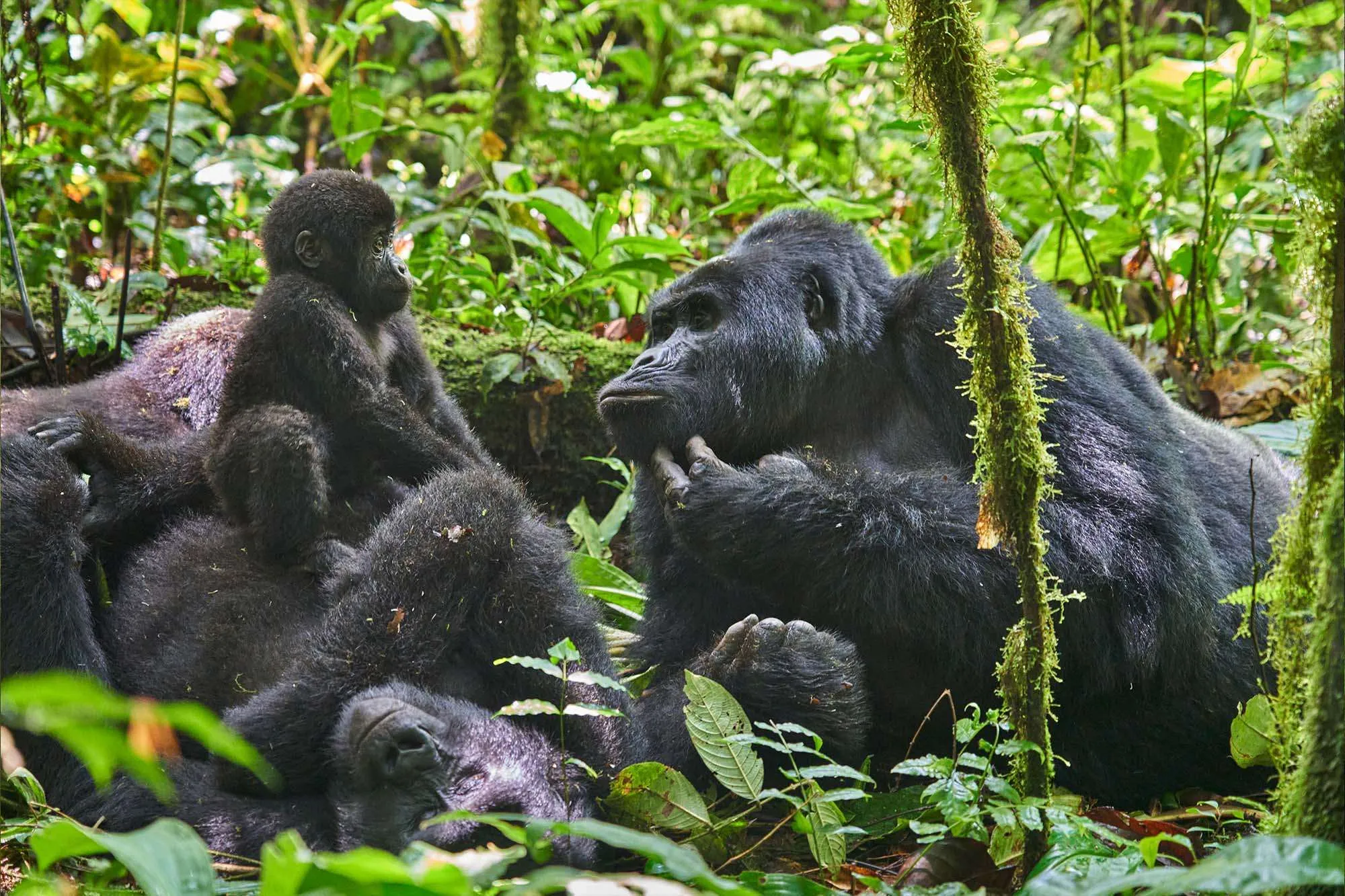
Mountain gorillas are highly social animals that live in organized groups known as gorilla families. Each family typically consists of 20 to 30 individuals, though some groups are smaller. Every family is led by a dominant male known as a silverback.
The silverback acts as the head of the family, providing protection and making all major decisions. Interestingly, they receive their name from the silver-grey fur that develops on their lower backs as they age. Consequently, the silverback is not just a leader but a seasoned protector of his kin.
How Many Gorilla Families are in Bwindi?
Bwindi Impenetrable National Park currently hosts over 50 gorilla families. However, it is important to note that only about 24 families are fully habituated and ready for trekking. These families are scattered across four distinct sectors: Buhoma, Nkuringo, Ruhija, and Rushaga. Below, we explore some of the most famous families you can encounter on a gorilla trekking safari in Uganda.
Famous Gorilla Families in the Buhoma Sector
1. Mubare Gorilla Family
The Mubare family is the oldest habituated group in Bwindi. Originally, the habituation process began in 1998 in the Mubare Hills. Led by the legendary silverback Ruhondeza, the family initially grew to 18 individuals. Unfortunately, the group lost many members over the years due to intense fights with other wild families.
By March 2013, the family had decreased to just 5 members. Nevertheless, the group has shown incredible resilience and currently consists of 11 individuals. Specifically, the family includes one dominant silverback (Kanyonyi), 6 adult females, 1 teenager, and 3 toddlers.
2. Habinyanja Gorilla Family
Located in the northern Buhoma sector, the Habinyanja family currently consists of 17 members. Notably, this group was once much larger, with over 25 members. Because of internal power struggles, the family eventually split, which led to the creation of the Rushegura family.
The name “Habinyanja” comes from the local Rukiga word for “source of water,” as the group was first sighted near a swamp pond in 1997. Today, the family is led by the silverback Makara and includes a diverse mix of blackbacks, juveniles, and infants.
3. Rushegura Gorilla Family
The Rushegura family formed in 2002 following its split from Habinyanja. Interestingly, the group took its name from “Ebishegura,” a tree species abundant in their home range. During 2010, the family grew to 19 individuals under the leadership of Mwirima, a remarkably calm silverback. Indeed, this family is considered the most peaceful in Bwindi, frequently visiting local village camps and interacting calmly with visitors.
The Research and Peace Seekers of the Ruhija Sector
4. Bitukura Gorilla Family
The Bitukura family is one of the most playful groups in Bwindi. While the group once had 24 members, internal disputes caused several individuals to leave. Consequently, the family now consists of 13 members. Remarkably, their habituation process in 2007 took only 15 months—much faster than the standard two years. Currently, the family is led by Ndahura, the second youngest silverback, who inherited power from the aging Karumanzi.
5. Kyaguriro Gorilla Family
Consisting of 15 individuals, the Kyaguriro family is the most treasured group in the park. This is because they are primarily reserved for scientific research. Sadly, their long-time leader Rukina died after being struck by lightning in 2015. Following his death, a young silverback named Mukiza briefly took over before being overthrown by an immigrating male named Rukara.
6. Mukiza Gorilla Family
Named after its founder, this family formed after Mukiza was banished from the Kyaguriro group. Rather than wandering alone, Mukiza broke away with a sizeable number of individuals to start his own lineage. Currently, this family consists of 10 members and resides within the Ruhija region.
The Newest Additions and the Rushaga Sector
7. Katwe Gorilla Family
The Katwe family is the newest habituated group in the Buhoma sector. After undergoing three years of habituation, the park officially opened this group for regular trekking in August 2018. Specifically, it comprises 9 individuals, including 1 silverback and 2 blackbacks.
8. Bweza Gorilla Family
Located in the southern Rushaga sector, the Bweza family consists of 12 individuals. Notably, this family came into existence after splitting from the Nshongi group. Once the silverback Mishaya had already split from Nshongi, Bweza decided to break away further with several females to establish his own dominant territory.
Plan Your Gorilla Trekking Experience
Gorilla trekking in Uganda is a life-changing adventure. Whether you choose the calm Rushegura family or the adventurous Susa groups, the experience supports vital conservation efforts. Furthermore, choosing group wildlife safaris in Uganda allows you to share this magnificent journey with fellow nature enthusiasts.