Lake Munyanyange, Uganda: The Beautiful Flamingo Lake in Queen Elizabeth National Park
Lake Munyanyange is one of the most fascinating hidden natural attractions in western Uganda. Famous for attracting lesser flamingos and other migratory waterbirds, this beautiful seasonal crater lake is an excellent destination for birdwatchers, nature lovers, photographers and travellers exploring Queen Elizabeth National Park.
Located near Katwe town in Kasese District, Lake Munyanyange is part of the remarkable Katwe-Kikorongo volcanic landscape. Unlike the large freshwater lakes of western Uganda, this small, shallow and saline crater lake has unique ecological characteristics that make it an important habitat for specialised bird species.
The lake is particularly famous for its seasonal flamingo populations, which attract visitors interested in observing these elegant pink birds in their natural environment.
Beyond birdwatching, a visit to Lake Munyanyange offers an opportunity to explore the fascinating crater lakes of Queen Elizabeth National Park, discover the traditional salt-mining activities at nearby Lake Katwe and experience the remarkable landscapes of the Albertine Rift Valley.
Whether you are planning a Uganda birdwatching safari, a wildlife holiday or a scenic adventure through western Uganda, Lake Munyanyange deserves a place on your itinerary.
In this travel guide, Epic Uganda Vacation explores the location, formation, flamingos, wildlife, attractions, activities and best time to visit Lake Munyanyange.
Where Is Lake Munyanyange Located?
Lake Munyanyange is located in Kasese District, western Uganda, near Katwe-Kabatoro Town Council and Queen Elizabeth National Park.
It lies northeast of Lake Katwe, within the Katwe-Kikorongo volcanic field, an area characterised by numerous volcanic craters and saline lakes.
The lake is situated north of Mweya Peninsula and forms part of the wider Queen Elizabeth conservation landscape.
Its location makes it an interesting stop for visitors exploring the northern section of Queen Elizabeth National Park and the surrounding crater-lake region.
Lake Munyanyange is relatively small and shallow, with seasonal changes in water levels influencing its appearance and the bird species that visit it.
The surrounding landscape includes volcanic terrain, grassland vegetation, saline soils and other crater lakes.
Lake Munyanyange at a Glance
Here are some interesting facts about Lake Munyanyange:
-
- Location: Near Katwe, Kasese District, western Uganda.
-
- Region: Albertine Rift Valley.
-
- Lake type: Saline volcanic crater lake.
-
- Size: Approximately 1.5 square kilometres, according to published tourism accounts.
-
- Main attraction: Seasonal flamingos and migratory waterbirds.
-
- Nearby attraction: Lake Katwe.
-
- Nearest major tourism centre: Mweya Peninsula.
-
- Ecological importance: Important wetland and bird habitat.
-
- Nearby protected landscape: Queen Elizabeth National Park and its associated conservation areas.
The lake is also sometimes spelled Lake Munyanyage in tourism publications.
The Formation of Lake Munyanyange
Lake Munyanyange is part of the Katwe-Kikorongo volcanic field in western Uganda.
The region was shaped by volcanic activity associated with the geological development of the western branch of the East African Rift System.
Ancient volcanic explosions created numerous craters and depressions across the landscape. Over time, some of these depressions filled with water, forming the crater lakes that are now among the distinctive natural attractions of Queen Elizabeth National Park.
Lake Munyanyange is one of these crater lakes.
Its saline characteristics are associated with the region’s underlying geology, mineral-rich groundwater and the accumulation of dissolved salts.
Unlike freshwater lakes, saline crater lakes support specialised organisms that can tolerate high salt concentrations.
These organisms, including algae and other microscopic life, contribute to the food chains that attract flamingos and other waterbirds.
Why Is Lake Munyanyange Famous for Flamingos?
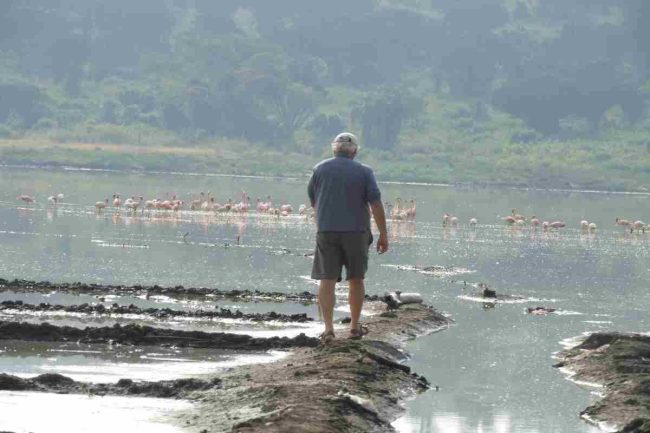
Lake Munyanyange is popularly known as the Flamingo Lake of Uganda because it attracts lesser flamingos and other waterbirds during suitable seasonal conditions.
The lake’s shallow, saline waters provide a favourable feeding environment for flamingos.
These birds use their specially adapted bills to filter small food organisms, including algae and other microscopic aquatic life, from the water.
When conditions are suitable, flamingos gather in groups, creating a spectacular natural display against the lake’s volcanic surroundings.
The lesser flamingo is particularly associated with East Africa’s alkaline and saline lakes, including Lake Natron in Tanzania.
Some flamingos visiting Uganda’s saline crater lakes are associated with the wider East African migratory movements.
Their presence at Lake Munyanyange makes it one of the interesting birdwatching destinations within the Queen Elizabeth National Park region.
However, flamingo numbers vary considerably depending on water levels, food availability and ecological conditions.
Flamingos and Other Birds Found at Lake Munyanyange
Lake Munyanyange is an important habitat for resident and migratory birds.
Its shallow waters and muddy shoreline provide feeding and resting areas for several bird species.
Birdwatchers visiting the lake may encounter:
-
- Lesser flamingos.
-
- Greater flamingos, where present.
-
- Lesser black-backed gulls.
-
- African jacanas.
-
- Pied avocets.
-
- Black-winged stilts.
-
- Various sandpipers.
-
- Herons.
-
- Egrets.
-
- Other migratory shorebirds.
The lake has also been recognised as an important birdwatching site because of its role as a seasonal resting and feeding area for migratory waterbirds.
Lesser Flamingos
Lesser flamingos are among the most attractive birds associated with Lake Munyanyange.
They are recognisable by their pinkish plumage, long legs, slender necks and distinctive downward-curved bills.
Their pink colour comes largely from pigments obtained through their food.
They feed on microscopic organisms, including algae, found in suitable saline and alkaline water environments.
When large flocks gather at Lake Munyanyange, visitors can enjoy beautiful views of the birds feeding, resting and moving through the shallow water.
Lesser Black-Backed Gulls
The lesser black-backed gull is another bird species associated with Lake Munyanyange.
These migratory birds use suitable wetlands as feeding and resting locations during their movements between breeding and non-breeding areas.
The lake’s muddy shores and shallow waters provide suitable conditions for several wading and waterbird species.
Other Migratory Waterbirds
Lake Munyanyange also attracts other migratory birds from different regions.
Their presence makes the lake interesting for birdwatchers who want to observe seasonal changes in Uganda’s wetland bird populations.
A local birding guide can help visitors identify different species and understand their migration patterns.
Best Time to See Flamingos at Lake Munyanyange
The best time to visit Lake Munyanyange for flamingo viewing depends on seasonal rainfall, water levels and the availability of food.
Published local travel accounts identify approximately October to April as a potentially favourable period for observing migratory birds, although sightings vary from year to year.
The lake is seasonal and can become very shallow or dry during prolonged dry conditions.
This means visitors should not expect flamingos to be present throughout the year.
For the best experience, consider the following:
October to December: A potentially rewarding period as seasonal rainfall replenishes some wetland habitats and migratory bird activity may increase.
January to February: Birdwatching opportunities depend on rainfall, water levels and the availability of feeding areas.
March to April: Some migratory waterbirds may still be present, although local conditions influence their numbers.
Before arranging a dedicated flamingo excursion, contact a local birding guide or tourism information centre to confirm recent sightings.
Top Things to Do at Lake Munyanyange
Lake Munyanyange offers several interesting experiences for travellers interested in nature and birdwatching.
1. Flamingo Watching
Flamingo watching is the main attraction at Lake Munyanyange.
Visitors can observe the birds feeding and resting in the shallow saline water when they are present.
Their pink feathers create a beautiful contrast against the lake’s surroundings.
For the best viewing experience, bring binoculars or a camera with a zoom lens.
Avoid approaching the birds too closely because unnecessary disturbance can cause them to fly away.
2. Birdwatching
Apart from flamingos, Lake Munyanyange attracts different species of waterbirds and migratory shorebirds.
Bird enthusiasts can spend time observing the lake’s birdlife and learning about the ecological importance of saline wetlands.
A guided birdwatching excursion can help visitors identify less familiar species and understand their behaviour.
3. Nature Photography
Lake Munyanyange is an interesting destination for wildlife and landscape photographers.
Its volcanic surroundings, saline shoreline, seasonal water levels and birdlife create unique photographic opportunities.
Flamingos are particularly attractive subjects when they gather in large groups.
Early morning and late afternoon can offer beautiful natural lighting, depending on weather conditions.
4. Explore the Katwe Crater Lakes
A visit to Lake Munyanyange can be combined with exploring other crater lakes in the Katwe area.
These lakes have different geological and chemical characteristics, creating a fascinating natural landscape.
Some nearby lakes include:
-
- Lake Katwe.
-
- Lake Nyamunuka.
-
- Lake Kasenyi.
-
- Other small volcanic craters in the surrounding region.
Exploring the crater lakes provides an opportunity to appreciate the volcanic history of western Uganda.
5. Visit the Lake Katwe Salt Mining Community
Lake Katwe is located close to Lake Munyanyange and is famous for traditional salt extraction.
For generations, local communities have depended on salt mining as an important economic activity.
Visitors can learn about traditional salt harvesting, local livelihoods and the history of the salt industry.
A guided community visit provides insight into how people have adapted to living around saline crater lakes.
6. Experience Local Culture
Katwe-Kabatoro is an interesting destination for travellers who want to learn about the communities living around Queen Elizabeth National Park.
Visitors can discover traditional livelihoods, local crafts, fishing activities and the relationship between tourism and conservation.
Community tourism can help visitors understand the importance of protecting the lake while supporting local economic development.
Other Attractions to Combine with Lake Munyanyange
One of the advantages of visiting Lake Munyanyange is its proximity to several attractions within Queen Elizabeth National Park.
Consider combining your visit with the following destinations.
1. Lake Katwe
Lake Katwe is a famous saline crater lake known for its traditional salt-mining activities.
Visitors can observe salt extraction and learn about the importance of the lake to surrounding communities.
2. Mweya Peninsula
Mweya Peninsula is one of the main tourism centres in Queen Elizabeth National Park.
It is surrounded by Lake Edward and the Kazinga Channel and offers excellent opportunities for wildlife viewing and boat cruises.
3. Kazinga Channel
The Kazinga Channel connects Lake George and Lake Edward.
It is famous for its large hippo populations, crocodiles, elephants and numerous waterbirds.
A boat cruise along the channel is one of the highlights of a Queen Elizabeth National Park safari.
4. Lake Edward
Lake Edward is one of the major freshwater lakes of the Albertine Rift Valley.
Its scenic landscapes and aquatic biodiversity make it an interesting destination for nature enthusiasts.
5. Kasenyi Plains
Kasenyi Plains is famous for Uganda kob and opportunities to spot lions during wildlife game drives.
It is one of the popular wildlife-viewing areas in Queen Elizabeth National Park.
6. Maramagambo Forest
Maramagambo Forest is a beautiful tropical forest within the Queen Elizabeth National Park landscape.
Visitors can enjoy guided nature walks, birdwatching and opportunities to explore the forest’s remarkable biodiversity.
7. Kyambura Gorge
Kyambura Gorge is famous for chimpanzee tracking and its beautiful forest environment.
It is an excellent addition to a longer Queen Elizabeth National Park itinerary.
Lake Munyanyange and Lake Katwe: What Is the Difference?
Lake Munyanyange and Lake Katwe are two separate saline crater lakes located close to each other near Katwe town.
Although they share the same volcanic landscape, their main tourism attractions are different.
| Feature | Lake Munyanyange | Lake Katwe |
|---|---|---|
| Main attraction | Flamingos and birdwatching | Traditional salt mining |
| Water characteristics | Saline | Highly saline |
| Location | Near Katwe town | Near Katwe town |
| Lake type | Seasonal crater lake | Saline volcanic crater lake |
| Tourism interest | Birdwatching and nature photography | Cultural tourism and salt extraction |
Visiting both lakes provides a more complete understanding of the Katwe volcanic landscape and the relationship between local communities and their natural environment.
Conservation Importance of Lake Munyanyange
Lake Munyanyange is an important ecological site because of its role in supporting migratory waterbirds and other wetland species.
Its saline waters and surrounding vegetation provide important feeding and resting habitats for birds.
The lake is also associated with the wider Kazinga Wildlife Sanctuary and the Queen Elizabeth conservation landscape.
Conservation organisations, including NatureUganda, have supported efforts to monitor and protect lesser flamingos and their habitats in Uganda.
Environmental Challenges Facing Lake Munyanyange
Like many small wetlands, Lake Munyanyange faces several environmental pressures.
These include:
-
- Encroachment on wetland habitats.
-
- Unsustainable land-use practices.
-
- Livestock grazing around sensitive areas.
-
- Waste disposal and pollution.
-
- Changes in rainfall and water levels.
-
- Disturbance of migratory birds.
-
- Degradation of surrounding vegetation.
Protecting the lake requires cooperation between local communities, conservation organisations, government authorities and tourism operators.
Responsible tourism can contribute to conservation awareness while providing economic opportunities for surrounding communities.
How to Get to Lake Munyanyange from Kampala
Lake Munyanyange can be reached by road from Kampala through western Uganda.
One common route follows:
Kampala – Masaka – Mbarara – Bushenyi – Kasese – Katwe.
Another option is:
Kampala – Mubende – Fort Portal – Kasese – Katwe.
The journey generally takes approximately 6–8 hours or longer, depending on the route, traffic and road conditions.
From Kasese, travellers continue towards Katwe-Kabatoro, where Lake Munyanyange is located near Lake Katwe.
A 4×4 safari vehicle is recommended for exploring the wider Queen Elizabeth National Park region, especially when visiting multiple attractions.
Visitors can also arrange domestic charter flights to suitable airstrips serving Queen Elizabeth National Park, followed by a road transfer.
For international travellers, arranging a guided Uganda safari is a convenient way to explore Lake Munyanyange and other attractions in western Uganda.
Where to Stay When Visiting Lake Munyanyange
Visitors exploring Lake Munyanyange can choose accommodation around Katwe, Mweya, Kasese and other parts of Queen Elizabeth National Park.
Accommodation options include:
Mweya Peninsula: An excellent choice for visitors interested in luxury safari accommodation, the Kazinga Channel and Lake Edward.
Katwe area: Convenient for travellers interested in Lake Munyanyange, Lake Katwe and local cultural experiences. Confirm current accommodation availability before booking.
Kasese: Suitable for visitors exploring Lake George, the Rwenzori Mountains and Queen Elizabeth National Park.
Queen Elizabeth National Park: Offers a range of safari lodges, tented camps and budget accommodation.
Choosing accommodation based on your planned activities can reduce unnecessary driving and make your safari more enjoyable.
Best Time to Visit Lake Munyanyange
Lake Munyanyange can be visited throughout the year, but the experience changes depending on rainfall and water levels.
The wetter months can create favourable feeding conditions for waterbirds, while prolonged dry periods may cause the lake to shrink or dry out.
For birdwatchers, the period from approximately October to April is worth considering because of the seasonal presence of migratory waterbirds.
For general sightseeing and exploring the surrounding crater lakes, the relatively drier periods of June to September and December to February can be more convenient.
Regardless of the season, checking recent bird sightings and local access conditions before travelling is recommended.
Why Visit Lake Munyanyange with Epic Uganda Vacation?
Lake Munyanyange offers a unique opportunity to discover one of Uganda’s lesser-known natural attractions.
Its seasonal flamingos, saline crater-lake environment, migratory birdlife and proximity to Lake Katwe make it an interesting destination for travellers seeking something different from conventional wildlife safaris.
At Epic Uganda Vacation, we help travellers discover Uganda through carefully organised nature experiences, wildlife safaris and birdwatching adventures.
We can help you arrange:
-
- Lake Munyanyange birdwatching excursions.
-
- Flamingo-watching experiences when birds are present.
-
- Lake Katwe salt-mining community visits.
-
- Queen Elizabeth National Park safaris.
-
- Kazinga Channel boat cruises.
-
- Mweya Peninsula accommodation.
-
- Uganda birdwatching tours.
-
- Combined wildlife and gorilla trekking holidays.
Whether you are a keen birdwatcher, nature photographer or first-time visitor to Uganda, we can help design a memorable travel experience based on your interests and budget.
Contact Epic Uganda Vacation today to plan your Lake Munyanyange birdwatching adventure and explore the beautiful crater lakes of Queen Elizabeth National Park.
Discover the Pearl of Africa through its extraordinary landscapes, wildlife and cultural heritage.
Frequently Asked Questions About Lake Munyanyange
1. Where is Lake Munyanyange located?
Lake Munyanyange is located near Katwe town in Kasese District, western Uganda, close to Queen Elizabeth National Park and Lake Katwe.
2. Why is Lake Munyanyange famous?
Lake Munyanyange is famous for attracting lesser flamingos and other migratory waterbirds, making it an interesting birdwatching destination in Uganda.
3. Can you see flamingos at Lake Munyanyange?
Yes, flamingos visit Lake Munyanyange when ecological conditions are suitable. However, their numbers vary depending on water levels, food availability and seasonal movements.
4. What is the best time to see flamingos at Lake Munyanyange?
October to April is a useful period to consider for migratory birdwatching, but sightings are not guaranteed. Confirm recent bird activity with a local guide before travelling.
5. Is Lake Munyanyange a crater lake?
Yes. Lake Munyanyange is a shallow saline crater lake formed through volcanic activity in the Katwe-Kikorongo volcanic field.
6. Is Lake Munyanyange salty?
Yes. Lake Munyanyange is a saline lake with mineral-rich water and a specialised ecosystem that supports certain algae and other organisms.
7. How far is Lake Munyanyange from Mweya Peninsula?
Lake Munyanyange is located north of Mweya Peninsula near Katwe town. The road journey generally takes around 30–45 minutes, depending on the route and conditions.
8. Can I visit Lake Munyanyange and Lake Katwe on the same day?
Yes. The two lakes are very close to each other, making it possible to combine birdwatching at Lake Munyanyange with a cultural visit to Lake Katwe’s salt-mining area.
9. What other birds can be seen at Lake Munyanyange?
Birdwatchers may encounter lesser black-backed gulls, pied avocets, African jacanas, sandpipers, herons, egrets and other waterbirds.
10. Can Lake Munyanyange be included in a Queen Elizabeth National Park safari?
Yes. Lake Munyanyange is an excellent addition to a Queen Elizabeth National Park itinerary, especially for travellers interested in birdwatching, crater lakes and cultural tourism.