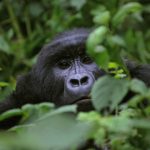
Sarambwe Nature Reserve, DR Congo: Location, Wildlife, How to Get There and Things to Do
Important travel note: Sarambwe Nature Reserve is an important part of the Bwindi–Sarambwe mountain gorilla ecosystem, but it is not currently an established tourist destination. The Greater Virunga Transboundary Collaboration states that tourism activities are not possible in the reserve because of instability in the Democratic Republic of Congo (DRC). Visitors should therefore not plan a самостоятель trek or expect normal visitor facilities there.
For travellers visiting southwestern Uganda, however, Sarambwe is an interesting conservation area to understand. It shares a boundary with Bwindi Impenetrable National Park, and its forests provide habitat for mountain gorillas and other wildlife that move across this international border.
This guide by Epic Uganda Vacation explains where Sarambwe is located, its wildlife and conservation importance, the current visitor situation, and how to reach the neighbouring Bwindi region.
1. Where is Sarambwe Nature Reserve located?
Sarambwe Nature Reserve is in the Rutshuru Territory of North Kivu Province in eastern DRC, close to the border with Uganda. It is directly connected to the northern part of Uganda’s Bwindi Impenetrable National Park, making it an important section of the wider Bwindi–Sarambwe forest ecosystem.
The reserve covers approximately 9 square kilometres (about 900 hectares). Although relatively small, it is ecologically significant because it protects part of the habitat used by endangered mountain gorillas.
Sarambwe is one of the protected areas associated with the wider mountain gorilla range shared by Uganda, Rwanda and the DRC.
2. Why is Sarambwe Nature Reserve important?
Sarambwe is important because mountain gorilla conservation does not stop at national borders. Gorillas living in the Bwindi landscape can move between Uganda’s Bwindi Impenetrable National Park and the neighbouring forest in the DRC.
Protecting Sarambwe helps maintain this connected habitat and supports the long-term survival of the Bwindi–Sarambwe mountain gorilla population.
The reserve also contributes to the protection of the Albertine Rift, a region recognised for its exceptional biodiversity. Its forest habitats support primates, birds, plants and other wildlife.
3. Wildlife in Sarambwe Nature Reserve
Despite its small size, Sarambwe supports several primate species. Records from the APES Atlas identify six primates in the reserve:
-
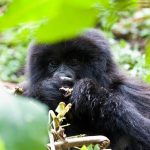
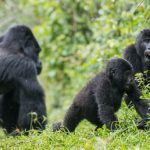
Mountain gorillas: Endangered great apes that use the connected Bwindi–Sarambwe forest landscape.
-
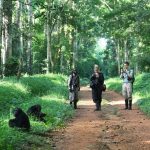
Chimpanzees: Another important primate species found in the reserve.
-
Olive baboons: Social primates that may be seen in forest-edge and open habitats.
-
Black-and-white colobus monkeys: Recognisable by their contrasting black and white coats and long tails.
-
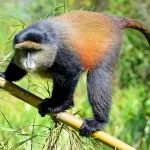
Blue monkeys: Forest-dwelling monkeys that feed on fruits, leaves and other vegetation.
-
Red-tailed monkeys: Small, active monkeys identified partly by their reddish tail markings.
The reserve is also part of a wider forest landscape supporting numerous bird and plant species. Its biodiversity makes it valuable for conservation research and habitat protection.
4. Mountain gorillas in Sarambwe Nature Reserve
One of Sarambwe’s most important conservation features is its role in protecting mountain gorilla habitat.
Mountain gorillas are found in two main populations: the Bwindi–Sarambwe landscape and the Virunga Massif, which includes protected areas in Uganda, Rwanda and the DRC.
Sarambwe forms part of the Bwindi–Sarambwe landscape. This means that the forest is not an isolated habitat; it is connected to Bwindi, allowing gorillas to move through the wider ecosystem.
The 2025 mountain gorilla census was launched across the Bwindi–Sarambwe ecosystem, demonstrating the importance of cross-border cooperation in monitoring and protecting these endangered primates.
Can tourists trek mountain gorillas in Sarambwe?
At present, travellers should not book a gorilla trekking experience directly in Sarambwe. The Greater Virunga Transboundary Collaboration reports that tourism is not possible in the reserve because of instability in the DRC.
Travellers who want to see mountain gorillas in this ecosystem can instead arrange a properly permitted trek in Uganda’s Bwindi Impenetrable National Park.
5. Things to do in Sarambwe Nature Reserve
It is important to distinguish between the reserve’s conservation value and activities currently available to tourists. Sarambwe does not presently operate as a conventional visitor destination, and visitors should not assume that guided walks, gorilla trekking, birdwatching excursions or camping can be booked there.
The following are important conservation interests associated with the reserve, rather than confirmed tourist activities.
5.1 Mountain gorilla conservation
Mountain gorillas are the reserve’s best-known wildlife attraction from a conservation perspective. Protecting their forest habitat and maintaining connections with Bwindi are essential for their survival.
5.2 Primate conservation
Sarambwe’s forest supports several primate species, including chimpanzees, colobus monkeys, blue monkeys and red-tailed monkeys. Protecting these species helps maintain the ecological balance of the forest.
5.3 Forest and biodiversity conservation
The reserve protects montane forest habitat in the Albertine Rift. Its vegetation provides shelter and food for wildlife, while helping maintain healthy forest ecosystems.
5.4 Conservation research and monitoring
Cross-border conservation organisations and wildlife authorities work together to monitor the wider Bwindi–Sarambwe ecosystem. Research and population monitoring help guide conservation decisions and identify threats to wildlife.
For an actual visitor experience, we recommend exploring Bwindi Impenetrable National Park instead. It offers established gorilla trekking, guided nature walks and birdwatching experiences.
6. How to get to Sarambwe Nature Reserve
Sarambwe lies in eastern DRC, along the Ugandan border. However, because tourism is currently not possible in the reserve, there is no recommended tourist access route into Sarambwe itself.
For travellers interested in the landscape, the practical option is to visit Bwindi Impenetrable National Park in Uganda. Bwindi is the neighbouring protected area and has established tourism infrastructure.
Getting to the neighbouring Bwindi Impenetrable National Park
By road from Entebbe or Kampala
The journey from Entebbe or Kampala to Bwindi generally takes most of a day, depending on the sector, road conditions and stops. Common routes pass through:
-
Kampala – Masaka – Mbarara – Kabale – Bwindi.
-
Kampala – Mbarara – Rukungiri – Kihihi – Buhoma.
-
Kabale – Kisoro – Rushaga or Nkuringo.
A 4×4 safari vehicle is recommended, particularly for the mountainous roads and the final approaches to the park.
By domestic flight
Travellers can save driving time by flying from Entebbe to an airstrip serving the Bwindi region. Kihihi is useful for the northern sectors, while Kisoro serves the southern sectors. A road transfer is required from the airstrip to the lodge or park sector.
From Kigali, Rwanda
Travellers can also reach southern Bwindi from Kigali by road, using the appropriate Rwanda–Uganda border crossing. The Cyanika crossing near Kisoro is useful for the southern sectors, while Katuna/Gatuna is commonly used for access through Kabale.
Border requirements, opening arrangements and travel conditions should be checked before departure.
Please note: These are routes to Bwindi, not permission or directions to enter Sarambwe Nature Reserve. Do not attempt to cross into the reserve independently.
7. Things to do near Sarambwe Nature Reserve
Although Sarambwe itself is not currently open for tourism, the neighbouring Bwindi region offers excellent wildlife and cultural experiences. Travellers can include these activities in a southwestern Uganda safari.
7.1 Mountain gorilla trekking in Bwindi Impenetrable National Park
Bwindi is one of the world’s most important mountain gorilla destinations. Visitors can book a guided trek to see a habituated gorilla family in its natural forest habitat.
Bwindi has four main gorilla trekking sectors:
-
Buhoma
-
Ruhija
-
Rushaga
-
Nkuringo
A gorilla trekking permit must be secured in advance through the Uganda Wildlife Authority or an authorised booking arrangement. The sector and permit availability should be confirmed before choosing accommodation.
Read our guide to Gorilla Trekking in Bwindi Impenetrable National Park when planning your visit.
7.2 Gorilla habituation experience
For visitors seeking a longer experience with mountain gorillas, Bwindi’s Rushaga sector offers the gorilla habituation experience, subject to permit availability and current Uganda Wildlife Authority regulations.
This activity allows visitors to accompany researchers and trackers as they follow a gorilla group undergoing habituation to human presence. It is different from the standard gorilla trek and requires its own permit.
7.3 Birdwatching in Bwindi
Bwindi is an excellent destination for birdwatchers. Its forests support many Albertine Rift endemic and regional bird species.
Birding can be arranged around the different park sectors, with local guides helping visitors search for forest specialists. Species sightings depend on season, location and conditions.
7.4 Batwa cultural experience
Visitors can learn about the traditional forest knowledge and cultural heritage of the Batwa community through organised community experiences near Bwindi.
These experiences provide an opportunity to understand the relationship between forest communities, traditional livelihoods and conservation. Choose responsible experiences led by local community organisations.
7.5 Guided forest walks
Bwindi also offers guided nature walks where visitors can explore the forest, learn about its plants and wildlife, and appreciate the ecological importance of this ancient montane forest.
These walks are a good option for travellers who want to experience the forest without undertaking a gorilla trek.
8. Best time to visit the Sarambwe region
Because Sarambwe is not currently operating as a tourist destination, there is no recommended visitor season for entering the reserve.
For a safari in the neighbouring Bwindi region, however, visitors can travel throughout the year.
The drier periods, generally June to August and December to February, are often preferred for gorilla trekking because forest trails may be less muddy. Rain can occur at any time, and Bwindi is a tropical rainforest.
The wetter months can still be rewarding for birdwatching and photography, although hiking conditions may be more challenging.
For a broader seasonal guide, see our article on the Best Time to Visit Bwindi Impenetrable National Park.
9. Safety and travel considerations
Safety is particularly important when discussing travel to eastern DRC.
The security situation in North Kivu has been unstable, and the Greater Virunga Transboundary Collaboration currently states that tourism activities are not possible in Sarambwe because of instability. Travellers should not treat the reserve as an accessible extension of a Bwindi gorilla trekking itinerary.
Before planning any travel in the wider region:
-
Check current travel advice from your government.
-
Seek current guidance from the relevant DRC authorities and conservation organisations.
-
Do not enter restricted forest areas or cross international borders outside official border posts.
-
Do not assume that a Uganda gorilla permit authorises entry into DRC.
-
Confirm border, visa and security requirements before travelling.
For visitors who want to experience mountain gorillas, Bwindi in Uganda is the practical alternative, with established visitor facilities and regulated trekking arrangements.
10. Sarambwe Nature Reserve and Bwindi: What is the difference?
| Feature | Sarambwe Nature Reserve | Bwindi Impenetrable National Park |
|---|---|---|
| Country | Democratic Republic of Congo | Uganda |
| Location | North Kivu, near Uganda’s border | Southwestern Uganda |
| Approximate area | 9 km² | About 331 km² |
| Mountain gorillas | Part of the Bwindi–Sarambwe habitat | Established gorilla trekking destination |
| Tourism status | Tourism currently not possible | Open for regulated tourism |
| Visitor facilities | No established tourist operation | Lodges, guides and park visitor services |
| Main importance | Cross-border habitat and conservation | Gorilla trekking, birding and forest experiences |
The two protected areas are ecologically connected, but their tourism arrangements are very different. Sarambwe’s conservation importance should not be confused with the established visitor experiences available in Bwindi.
11. Frequently asked questions about Sarambwe Nature Reserve
1. Where is Sarambwe Nature Reserve located?
Sarambwe Nature Reserve is located in Rutshuru Territory, North Kivu Province, in eastern Democratic Republic of Congo. It borders Uganda’s Bwindi Impenetrable National Park.
2. Is Sarambwe Nature Reserve open to tourists?
Tourism is currently not possible in the reserve according to the Greater Virunga Transboundary Collaboration. Visitors should check with the relevant conservation authorities for any future changes.
3. Are there mountain gorillas in Sarambwe?
Yes. Mountain gorillas use the forest habitat connecting Sarambwe and Bwindi. The reserve forms part of the wider Bwindi–Sarambwe mountain gorilla ecosystem.
4. Can I go gorilla trekking in Sarambwe?
No established tourist gorilla trekking activity is currently available in Sarambwe. Travellers can book regulated mountain gorilla trekking in neighbouring Bwindi Impenetrable National Park in Uganda.
5. How big is Sarambwe Nature Reserve?
The reserve covers approximately 9 square kilometres, equivalent to about 900 hectares.
6. What animals live in Sarambwe Nature Reserve?
Recorded primates include mountain gorillas, chimpanzees, olive baboons, black-and-white colobus monkeys, blue monkeys and red-tailed monkeys. The forest also supports other biodiversity.
7. Can I visit Sarambwe from Bwindi?
Although the two protected areas are connected, visitors should not assume that they can cross from Bwindi into Sarambwe. Entry into the reserve is subject to DRC regulations, security conditions and conservation authority approval.
8. What can I do near Sarambwe Nature Reserve?
In neighbouring Bwindi, visitors can enjoy mountain gorilla trekking, gorilla habituation, birdwatching, guided forest walks and Batwa cultural experiences.
12. Plan a Bwindi gorilla safari with Epic Uganda Vacation
Sarambwe Nature Reserve is a reminder that mountain gorilla conservation extends beyond national boundaries. Although the reserve is not currently available for conventional tourism, its connection to Bwindi makes it an important part of the wider conservation story.
At Epic Uganda Vacation, we organise tailor-made Uganda gorilla trekking safaris, wildlife tours, birdwatching holidays and cultural experiences. We can help you plan a Bwindi visit, select the appropriate gorilla trekking sector, arrange permits, choose accommodation and organise comfortable transport.
Whether you are interested in a short gorilla trekking trip or a longer Uganda safari combining Bwindi, Queen Elizabeth National Park, Kibale Forest and Lake Bunyonyi, we can help design an itinerary around your travel dates and interests.
Contact Epic Uganda Vacation to start planning your Uganda gorilla safari.