Kidepo Valley National Park: Uganda’s Hidden Wilderness
Kidepo Valley National park is located in Karamoja province, the northeastern part of Uganda. It is Uganda’s most beautiful, remote and least-explored park. The name is believed to have originated from the native word “KIDEP” meaning pick.
Kidepo valley national park, managed by Uganda Wildlife authority, occupies a space of roughly 1442sqkm. Its elevation ranges from 914 meters on the valley floor of Kidepo to 2749 meters, the peak of Mount Morungole near Karenga in Kabong District. Moreover, Kidepo Valley is approximately 220 kilometers (140 mi) by road northwest of Moroto. It is also 520 kilometers northeast of Kampala, Uganda’s largest city.
It shares its borders with South Sudan and Kenya’s Northern Frontier District. The northwestern edge of the park spreads along the international frontier with Bira and South Sudan. In fact, this was at one point the playground of the late president Idi A min, thus holding some historical substance. Furthermore, you can still visit the haunting ruins of the cottage. Unfortunately, during this period, there was rampant poaching of gem that left the area empty.
This place was first occupied by Ketebo clan who were the farmers and hunters in the period since 1800. Before it was gazetted as a game reserve by the British colonial government in 1958, they lived there to reserve the animals that were being wiped out through hunting, clearing the bush and bush burning. However, the eviction of the residents came with famine, especially for the Ketebo people. They were forcefully shifted to other areas within Bira such as Napotpot, Kalo Kudo, Namosingo, Loriwo and Naurkori in South Sudan.
When Obote’s government came into power, it turned the reserve area into Kidepo Valley National Park in 1962 with Ian Ross, a Briton. In 1972, he became the first chief warden and was replaced by Paul Ssali, who was Ugandan. Their handover and training became the subject of the 1974 American documentary film, “The Wild and the Brave.”
Kidepo valley national park is blessed with a large biodiversity of open tree savannah since it has differences in rainfall. The annual averages are 89 centimeters in Naruks and 64 centimeters in the Kidepo basin. As a result, vegetation and animal populations vary between the two valleys of Narus.
Narus Valley possesses the short red oat grass and taller bunchy Guinea grass and fine thatching grass which are Common tree species. Not forgetting the red thorn acacias, desert dates, and to a lesser extent drumstick trees. The amazing sausage trees divide the water floor. In the same place, we find Euphorbia candelabrum, the shorter monkey bread, and Buffalo thorn trees.
Also, the persistent rainwater makes River Kidepo a refuge in the semi-desert area which is home to approximately 86 mammal species. These include the spotted hyena, lion, cheetah, leopard, wild dog, elephant, giraffe, zebra, African buffalo, bat-eared foxes, Rothschild’s giraffe. There are also over 476 bird species recorded in the same area.
Bird watching in the park.
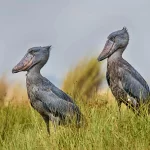
This destination is home to over 475 recorded bird species thus making it a perfect place for birding. It welcomes birds from all over the world for holidays or even breeding because of her large biodiversity. For example, you will see Ostriches, Superb Starling, Vinaceous Dove, Brown-backed Woodpecker, Hoopoe, Little Green Bee-eater, Long-tailed & Standard-winged Nightjars, White-bellied Tit, Mosque Swallow, Karamoja Apalis, Nubian Woodpecker, Red-fronted & Black-breasted Barbets, Pygmy Falcon, African Grey Flycatcher, Eastern Yellow & Jackson’s Hornbills, Red-winged Lark, to mention but a few.
Game Viewing:
Once at Kidepo Valley, visitors have great chances of viewing different gem right from the big5 cats to several animals enjoying the large Kidepo wilderness. Some of these animals include the resident Carnivore species only endemic to Kidepo and the Karamoja region namely the hunting dog, bat-eared fox, cheetah, striped hyena, caracal, and aardwolf. Moreover, we have lions, common zebras, leopards, plus many small cats such as the side-striped jackal, Kangoni, black-backed jackal and spotted hyena. In addition, this park also harbors five primate species including the Kavirondo bush baby being the most endemic. You can also find Oribis within the Narus Valley, Guenther’s Dik, and several reptiles.
Hiking/ Scenery viewing
For all those interested in hiking, it will only require time and fitness to hike some of the mountains near the park’s headquarters, such as Lamoj Mountains among others. Thereafter, you can also pay a visit to the fascinating Kidepo river valley, mainly covered by Borassus palm forest. Just 11 kilometers from Kidepo Valley are the Kanangorok hot springs, which are worth visiting as well.
Cultural Performance;
Areas around Kidepo Valley National park are gifted with authentic tribes that welcome and take visitors through their cultures. They have cultural performances, such as traditional dances including the Emuya of the Nyangi and Apiti dances of the ethnic Acholi people, and others.
You can also visit the primitive IK people. They believe in their culture and are never moved by the modern changes.
Nature Walk in the park;
Some places are well explored while on foot. So, you can learn more about the African culture as you visit the Karamajongs homesteads, which are locally referred to as manyattas. You may visit the kraals to view their traditional costumes, jewelry, stools, bows & arrows, spears, headdress plus knives. You can also purchase some of the local Karamajongs traditional items as souvenirs from the tourist offices of the park.
Getting to Kidepo.
There are chartered flights from Entebbe International Airport to the headquarters of the park. The Civil Aviation Authority runs an airstrip found at Lomej, approximately 3 km south of the headquarters of the park.
Yes, this beautiful wildlife park is quite unvisited. However, that status is not going to last much longer. With road improvement and the availability of flights to the park, visiting the park has been made easier. Therefore, more and more visitors will be making the journey to this otherwise remote piece of heaven.