Everything you must know about Rusizi National Park. In the far west of Burundi, where the highlands of the interior tumble dramatically towards the Great Rift Valley, lies a landscape of striking contrast and vibrant life. Rusizi National Park (Parc National de la Rusizi), often referred to simply as the Rusizi Reserve, is a jewel in the crown of Burundi’s protected areas.
Located merely 15 kilometres north of the economic capital, Bujumbura, this park offers one of the most accessible yet profound wildlife experiences in Central Africa. It is a place where the dynamic waters of the Rusizi River spill into the vast expanse of Lake Tanganyika, creating a unique delta ecosystem that sustains an astonishing density of flora and fauna. While it may be smaller in stature than the mountainous Kibira or the expansive Ruvubu, Rusizi National Park holds its own distinct charm, defined by water, heat, and the raw energy of the African wilderness.
Geography and Formation of Rusizi National Park
The story of Rusizi National Park is written in water. The park stretches along a section of the Rusizi River, which serves as the natural frontier between Burundi and the Democratic Republic of the Congo (DRC). Covering an area of approximately 100 square kilometres, divided into two main sections, the park encompasses a diverse range of habitats: the riverine environment, the delta (cuvette), and the palm savannah.
The Rusizi River is a geographical paradox of great interest. While many rivers flow into Lake Tanganyika, the Rusizi is one of the few that flows out of it for a portion of its course, before eventually feeding back into the lake’s northern basin. This hydrological dance creates a complex and fertile environment. The river’s terminus at Lake Tanganyika forms a sprawling delta, a labyrinth of channels, lagoons, and swamplands that are constantly shifting with the seasons.
This delta, or “cuvette,” is the ecological heart of the park. It acts as a massive natural filter for the waters entering the lake and a nutrient trap that supports a food web of incredible productivity. The park sits within the western extension of the Albertine Rift, a geological depression that has created the deep waters of Lake Tanganyika. The climate here is that of the “Imbo” plain, the low-lying region of Burundi characterised by high temperatures and humidity. This tropical heat, often intensifying the air to a shimmering haze, fuels the rapid growth of the lush vegetation that blankets the riverbanks.
The Kingdom of the Hippopotamus
For most visitors to Rusizi, the primary attraction is the hippopotamus. The park is famous for harbouring one of the highest concentrations of hippos in Africa. The riverbanks and the quiet backwaters of the delta provide the perfect habitat for these amphibious giants. On any given boat trip or guided walk along the river, one can expect to see dozens, if not hundreds, of these massive animals.
The hippos of Rusizi are a constant presence. During the heat of the day, they pack themselves into the water to keep their sensitive skin cool and moist, a writhing mass of grey flesh that occasionally erupts in splashing disputes or the resonant “wheeze-honk” calls that echo over the water. As the sun begins to dip, casting long golden shadows over the river, they emerge onto the grassy banks to graze. Watching a herd of hippos emerge from the reeds, their massive silhouettes outlined against the sunset, is one of the iconic images of a Burundian safari.
However, the abundance of hippos is not without its challenges. The riverbanks are heavily grazed, leading to significant soil erosion in some areas. Furthermore, hippos are notoriously territorial and dangerous. In the past, conflicts between hippos and local villagers have occurred when the animals leave the protected confines of the park to raid crops at night. The park authorities work hard to manage these boundaries, ensuring that the river remains a sanctuary for the wildlife while protecting the livelihoods of the surrounding communities.
The Nile Crocodiles
Sharing the river with the hippos is another apex predator: the Nile crocodile. The Rusizi River and the adjoining Lake Tanganyika are home to a healthy population of these ancient reptiles. They are often seen basking on the sandy banks, mouths agape to regulate their body temperature, looking for all the world like logs washed up on the shore.
The crocodiles of Rusizi inspire a mixture of fear and fascination. They are the silent ambush predators of the ecosystem, capable of taking down large prey that comes to drink. The local lore is rich with stories of these creatures, and the region was once reportedly home to “Gustave,” a legendary Nile crocodile rumoured to be the largest in Africa and the subject of numerous documentaries and thrillers. While the veracity of Gustave’s specific size and history is debated, he serves as a symbol of the untamed power of the Rusizi River. Even today, the sight of a large crocodile sliding silently into the dark water is a reminder that in this wilderness, humans are merely visitors.
Sitatungas and the Floodplains
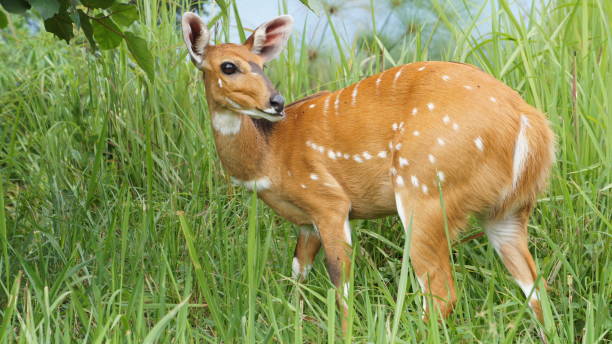
While the aquatic giants dominate the water, the elusive sitatunga antelope rules the marshes. The Rusizi delta is arguably one of the best places in East Africa to spot these shy and semi-aquatic antelopes. Perfectly adapted to their swampy habitat, sitatungas have long, splayed hooves that prevent them from sinking into the mud, and a waterproof coat that helps them navigate the reed beds.
Spotting a sitatunga requires patience and a keen eye. They are solitary or found in small pairs, moving silently through the dense papyrus and reeds. They are experts at camouflage, often freezing motionless when they sense danger, blending seamlessly into the tall vegetation. The preservation of the wetlands within Rusizi National Park is critical for the survival of the sitatunga, as their specialised habitat is under threat across much of their range.
Beyond the swamps, the park transitions into a palm savannah. This open area is grazed by herds of impala and the majestic topi, an antelope with a reddish-brown coat and distinctively darker thighs. These savannah dwellers are more easily seen, often grazing in clearings or standing sentinel on termite mounds, scanning for predators. The contrast between the wet, marshy delta and the dry, rustling palm savannah creates a biodiversity “hotspot” within a relatively small area.
A Birder’s Paradise at the Lake’s Edge
For ornithologists, Rusizi National Park is nothing short of paradise. The convergence of the river and the lake creates a magnet for waterbirds. The park is home to over 200 bird species, including several endemic to the Albertine Rift and the Zambezian biome.
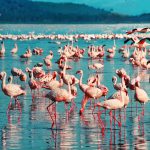
The open waters and marshes teem with activity. The majestic African Fish Eagle is a common sight, its distinctive cry piercing the air as it swoops down to snatch fish from the river. Flocks of Open-billed Storks patrol the shallows, using their uniquely adapted bills to pry open snail shells. Great White Pelicans gather in large, noisy groups, while various species of egrets and herons stalk the shallows with patient precision.
One of the avian highlights of the Rusizi is the African Skimmer. These striking birds, with their distinctive red and black beaks, fly low over the water’s surface, skimming the lower mandible through the water to catch small fish, a delicate, balletic display that is a thrill to witness. The gallery forests along the river banks are home to colourful kingfishers, bee-eaters, and turacos, adding flashes of brilliant blue, emerald, and crimson to the predominantly green and brown landscape.
The Palm Savannahs and the Baobabs
Away from the water’s edge, the landscape of Rusizi is dominated by the “Hyphaene” palms, also known as the Doum palm. These palms create a unique skyline, their fan-shaped leaves silhouetted against the sky. In some areas, the park is home to a remarkable forest of these palms, which provide a vital food source for wildlife; the elephant population (though smaller and more elusive than in the past) relies on the fruit of the Doum palm, as do baboons and monkeys.
Adding to the botanical diversity is the presence of Baobab trees. These iconic “upside-down” trees stand as sentinels on the plains, their massive trunks storing water to survive the dry season. There is one particularly famous baobab within the park limits, known as the “Sole Baobab,” which serves as a landmark and a picnic spot for visitors. Sitting in the shade of a baobab that has stood for hundreds of years, watching the hippos in the river below, connects the visitor to the ancient, timeless rhythm of the African landscape.
The Visitor Experience in Rusizi National Park
One of the greatest assets of Rusizi National Park is its accessibility. Located so close to Bujumbura, it is an easy day trip for those staying in the capital or lakeside towns. The park offers a variety of activities that allow visitors to immerse themselves in the environment.
The most popular activity is undoubtedly the guided boat tour. Skilled local guides navigate small motorboats through the channels of the delta. This vantage point offers an intimate look at the hippos and crocodiles and allows access to parts of the park that are impossible to reach on foot. The sensation of gliding silently through the papyrus, with the towering mountains of the Congo looming on the opposite bank, is deeply atmospheric.
For those who prefer to stay on land, guided walking safaris are available. Accompanied by armed rangers (necessary due to the proximity of potentially dangerous wildlife), visitors can walk along the riverine forest trails and through the palm savannah. This allows for closer inspection of the flora, insects, and smaller birdlife. It is an exhilarating experience to walk on the same trails used by buffalo and leopard, feeling the pulse of the bush from the ground level.
Fishing is also a major draw. The waters near the park are known for Nile Perch and Tiger Fish, attracting anglers from around the region. While sport fishing is often conducted slightly outside the strict conservation zones, the proximity to the park ensures that the surrounding waters remain rich and biodiverse.
Conclusion
Rusizi National Park is more than just a collection of animals; it is a living system, a breathing entity that defines the western border of Burundi. It is a place of intense beauty. Here, the lush green of the delta meets the deep blue of the lake and the fiery orange of the sunset. It serves as a critical sanctuary for species that are under pressure elsewhere, a refuge where the sitatunga can hide in the reeds and the hippo can wallow in the deep pools.
For the traveller, it offers a different side of Burundi, not the cool mist of the mountains or the rolling tea fields, but the heat, the humidity, and the vibrant life of the riverine plain. It is a place that reminds us of the power of water to shape landscapes and sustain life. As the sun sets over the Rusizi River, painting the sky in hues of purple and gold, and the night sounds of the African bush begin to stir, one realises that this small patch of wilderness is a priceless treasure, a wild heart beating strongly on the shores of the great lake.