Kigwena Forest Natural Reserve: Along the dramatic escarpment where the highlands of Burundi tumble down towards the shimmering expanse of Lake Tanganyika, there lies a world that feels entirely removed from the cool, misty peaks of the interior. This is the domain of the Kigwena Forest Natural Reserve (Réserve Naturelle de la Forêt de Kigwena). While often overshadowed by the vast expanses of Kibira or the celebrity status of Rusizi’s hippos, Kigwena offers a distinct and intoxicating slice of African nature. It is a fragment of lowland tropical rainforest, a steaming, verdant pocket of biodiversity that clings to the mountainside, preserving a unique ecosystem that acts as a bridge between the savannahs and the deep waters of the lake.
The Lowlands of Kigwena Forest Reserve
Located in the Rumonge and Bubanza provinces, roughly halfway between the economic capital, Bujumbura, and the southern tourist hub of Rumonge, Kigwena covers an area of approximately 3,300 hectares. It is classified as a Natural Reserve rather than a National Park, a designation that speaks to its specific ecological role and its smaller size. Yet, what it lacks in square mileage, it more than makes up for in intensity.
Kigwena is a rare survivor. Centuries ago, a vast belt of dry tropical rainforest covered much of the western foothills of the Congo-Nile Ridge. Today, agriculture and settlement have decimated these forests, leaving Kigwena as one of the last remaining vestiges of this unique habitat. It sits at an altitude ranging from roughly 770 to 1,600 meters, creating a transitional zone between the montane forests of the interior and the lowland plains of the Rift Valley floor.
This geographical positioning creates a specific microclimate. The reserve is warm and humid, often pulsating with a heat that feels distinctly different from the bracing air of Kibira. The forest acts as a sponge, catching the moisture rising from Lake Tanganyika and the rains descending from the mountains, resulting in a lush, dense, and sometimes oppressive atmosphere that fuels rapid plant growth. It is, in essence, a hothouse of African flora and fauna.
Flora of Kigwena
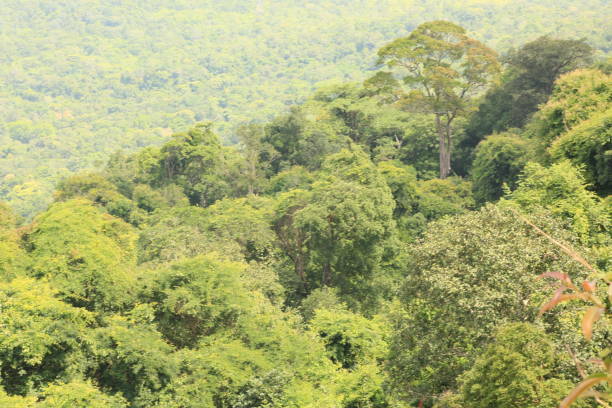
Entering Kigwena is like stepping into a green cathedral. The most striking feature of the forest is the sheer size of its trees. Unlike the stunted, wind-blown vegetation found at higher altitudes, Kigwena boasts towering hardwoods that reach for the sky. The forest is dominated by majestic specimens of Pericopsis and Milicia excelsa (Iroko), alongside massive fig trees whose buttress roots are like walls of ancient wood, twisting over the forest floor.
One of the botanical highlights of Kigwena is the presence of the Giant Fig tree (Ficus burtt-davyi). These arboreal giants are keystone species; their fruit feeds a wide variety of animals, and their hollow trunks often provide homes for bats and birds. Walking through the reserve, one is constantly craning one’s neck to admire the canopy, which is so dense in places that it blocks out the midday sun, creating a twilight world on the forest floor.
Beneath the giants lies a tangled understory of palms, lianas, and ferns. The forest floor is carpeted with a thick layer of decaying vegetation, which hums with the activity of insects and fungi. The “Raphia” palm is particularly abundant here, its leaves used locally for thatching and weaving. The sheer density of the vegetation makes the forest feel impenetrable in places, reinforcing the sense of entering a wild, primordial world untouched by time.
The Home of Primates
While the plant life is spectacular, it is the animal life that draws most visitors to Kigwena. The reserve is perhaps best known as a sanctuary for chimpanzees (Pan troglodytes schweinfurthii). Although the population here is smaller than in the neighbouring Kibira National Park, the chimps of Kigwena are significant.
Crucially, Kigwena acts as a potential biological corridor. Conservationists dream of a day when this reserve is reconnected to Kibira, further east and Rusizi to the south, allowing chimpanzees and other mammals to move freely between these protected zones. Currently, however, the forest remains somewhat of an island. Tracking chimpanzees in Kigwena is a raw adventure; the terrain is steep and slippery, and the chimps are mobile and shy. To hear their distinctive pant-hoots echoing through the valley is a thrill that resonates with the primal part of the human brain.
Beyond the chimpanzees, the forest is alive with monkeys. The handsome Black-and-white Colobus monkey is frequently seen, leaping spectacularly from branch to branch. Their contrasting coats make them easy to spot against the deep green foliage, and their long, bushy white tails hang like pendulums as they feed on leaves. Visitors may also encounter the Blue Monkey and the Vervet Monkey, as well as the elusive Olive Baboon, which often forages on the forest floor.
The Canopy and the Trail
For the visitor, Kigwena offers an intimate forest experience. The main attraction is a well-maintained network of trails that wind through the reserve. The most famous of these is the “Liana Bridge” experience. While modern canopy walks in East Africa often involve steel suspension bridges, the experience at Kigwena is far more rustic. The forest is crisscrossed by massive, thick lianas (woody vines) that hang like ropes from the canopy. For the adventurous, these vines offer a way to swing or pull oneself up the steep slopes, evoking the spirit of Tarzan. It is a physical, hands-on interaction with the forest that connects the visitor to the ecosystem in a tangible way.
The hiking here is serious. Because the forest sits on a slope, trails often involve steep ascents and descents. The heat and humidity add to the physical challenge, making a good level of fitness necessary. However, the exertion is rewarded with sightings of dazzling butterflies, including the majestic African Swallowtail, and the chance to spot smaller forest creatures like duikers (small antelopes) that dart silently through the undergrowth.
The forest also has its voices. As the sun begins to set, the soundscape changes. The chatter of monkeys fades, replaced by the eerie calls of tree hyraxes and the symphony of crickets and cicadas. Night walks are occasionally organised, offering a chance to see the nocturnal side of the forest, including bushbabies with their massive, reflective eyes.
Nyakazu Hot Springs
No visit to the Kigwena Forest Natural Reserve is complete without a stop at the adjacent Nyakazu Hot Springs (also known as the Source Chaude). Located just at the periphery of the forest, these springs are a geological marvel connected to the tectonic activity of the Great Rift Valley.
The water emerges from the ground at a scalding temperature, boiling with minerals that are said to have therapeutic properties. The site is beautifully situated, surrounded by the thick vegetation of the forest reserve. For the local community, these springs are not just a tourist attraction but a place of healing and social gathering.
There is a fascinating juxtaposition here: the boiling, turbulent water of the hot springs and the cool, shaded, quiet interior of the forest nearby. Legend and local lore often surround these springs, adding a layer of cultural mystique to the natural wonder. After a sweaty, steep hike through the humidity of the forest, the steam rising from the springs creates a spa-like atmosphere, allowing visitors to relax their muscles and soak in the tranquility of the environment. It is a perfect example of how Burundi’s landscape offers diverse experiences packed closely together.
Come Explore Kigwena Forest Reserve
Kigwena Forest Natural Reserve is a gem that hangs in the balance. It is a fragile pocket of biodiversity that represents the lowland forests of a bygone era. Its preservation is critical, not just for the chimpanzees that call it home. But for the health of the surrounding environment. The forests protect the watershed, preventing erosion on the steep slopes and filtering the water that flows down into Lake Tanganyika.
For the traveller, Kigwena offers an authentic, rugged, and deeply rewarding experience. It is a place that challenges you physically, but rewards you with solitude, beauty, and a profound connection with nature. It reminds us that conservation is not just about protecting vast tracts of land. But also about safeguarding these smaller, unique ecosystems that serve as sanctuaries for life.