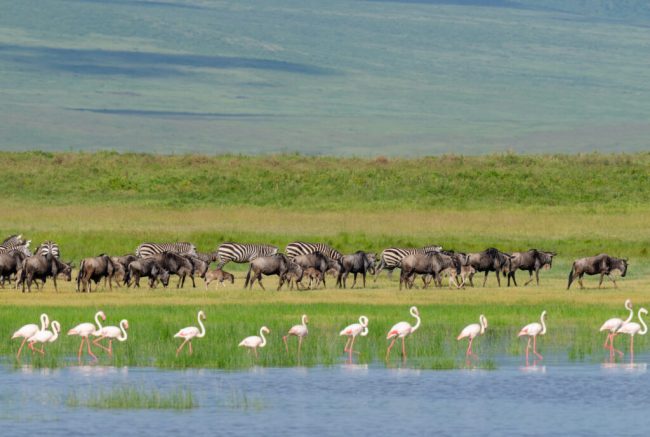
The Ndutu Lake Region is one of the most fascinating areas of northern Tanzania, known for its wildlife, volcanic landscapes, archaeological importance, and its central role in the annual Great Wildebeest Migration. Located in the southern Serengeti and extending toward the Ngorongoro Conservation Area, Ndutu is particularly famous for the wildebeest calving season, when hundreds of thousands of animals gather across the short-grass plains.
Beyond wildlife, however, Ndutu has a much deeper story. The region contains ancient lake basins, volcanic ash deposits, archaeological sites, and evidence connected to the long history of human evolution in East Africa. The Ndutu landscape therefore combines safari tourism, geology, ecology, archaeology, and human history in one remarkable destination.
Here are some important facts about the Ndutu Lake Region.
Ndutu Is Located Between the Serengeti and Ngorongoro
The Ndutu area lies in northern Tanzania in the transition zone between the southern Serengeti and the Ngorongoro Conservation Area. This location is important because wildlife does not follow human administrative boundaries.
The broader Serengeti-Mara ecosystem extends across Tanzania and Kenya, supporting one of the world’s most significant wildlife migrations. UNESCO describes the Serengeti as a vast savanna ecosystem covering about 1.5 million hectares, with enormous annual movements of wildebeest, zebras and gazelles. Ndutu is consequently an important part of the southern portion of this ecosystem.
Lake Ndutu Is a Seasonal Lake
Despite its name, Lake Ndutu is not a large permanent freshwater lake like Lake Victoria or Lake Tanganyika. It is part of a landscape of shallow lakes and seasonal water bodies associated with the Ndutu basin. Water availability changes according to rainfall and seasonal conditions. During wetter periods, the lake and surrounding wetlands can provide valuable water and habitat for wildlife. The broader Ndutu and Masek basins have a geological history extending back to the Pleistocene. According to UNESCO documentation, the Ndutu basin is associated with ash deposits from Ol Doinyo Lengai, the active volcano in northern Tanzania. This volcanic influence has helped shape the soils and ecology of the surrounding plains.
Ndutu Is Famous for Wildebeest Calving
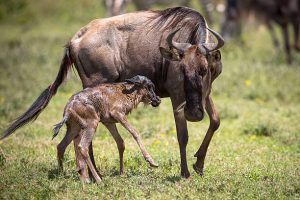
One of the biggest facts about the Ndutu region is its importance during the Great Wildebeest Migration. Every year, enormous herds move into the southern Serengeti and surrounding plains during the calving period. The most important calving months are generally January, February and March, although the exact timing can vary according to rainfall and grazing conditions. Tanzania National Parks describes the southern Serengeti, particularly the Ndutu area and surrounding short-grass plains, as the heart of the annual calving season. Its 2026 tourism publication states that more than half a million wildebeest give birth within a few weeks during this period. This makes Ndutu one of the most important wildlife-viewing areas in Tanzania during the early months of the year.
The Short Grass Is Extremely Important
The vegetation around Ndutu is not simply scenery for safari visitors. The short grass plains play a critical ecological role. The soils in this part of northern Tanzania have been influenced by volcanic ash. These mineral-rich soils support nutritious grasses that are particularly valuable to pregnant wildebeest and mothers nursing newborn calves. Tanzania National Parks notes that the short-grass plains preferred by wildebeest for calving have highly nutritious vegetation associated with volcanic ash deposits. The relationship between geology, soil, grass and wildlife is therefore one of the key reasons why Ndutu became such an important part of the migration cycle.
Thousands of Calves Can Be Born in a Short Period
Wildebeest calving in the Serengeti is remarkable because births are highly concentrated. TANAPA explains that hundreds of thousands of calves can be born during the short calving period. Earlier park information estimated that around 8,000 to 12,000 wildebeest calves can be born per day during the peak of the season. This synchronized reproduction provides an important survival strategy.
Predators are attracted by the enormous number of newborn animals, but the sheer number of calves also means that predators cannot capture every newborn. Within minutes of birth, a healthy wildebeest calf can become mobile and begin following its mother.
Predators Follow the Migration
Where there are huge numbers of herbivores, predators are never far away. During the Ndutu calving season, visitors can encounter lions, cheetahs, leopards, spotted hyenas and other predators hunting across the plains. The Serengeti ecosystem supports one of the world’s largest predator-prey systems. UNESCO identifies lions, leopards, cheetahs, hyenas and other predators among the major wildlife associated with the ecosystem. For photographers and wildlife enthusiasts, this predator activity is one of the major attractions of visiting Ndutu during calving season.
Ndutu Is More Than Just Wildebeest
Although wildebeest are the main attraction during migration season, Ndutu supports a variety of other wildlife. Depending on the season and location, visitors may encounter: Zebras, Thomson’s gazelles, Grant’s gazelles, Lions, Cheetahs, Leopards, Spotted hyenas, Ostriches, Giraffes, Jackals, Warthogs, Buffaloes, and Various bird species. The surrounding Serengeti ecosystem contains exceptionally high biodiversity. UNESCO records hundreds of bird species and numerous large mammal species across the Serengeti landscape.
Ndutu Has Major Archaeological Importance
One of the lesser-known facts about the Ndutu region is its importance to human evolution research. The wider Ngorongoro Conservation Area contains archaeological and palaeoanthropological sites that preserve evidence spanning millions of years. UNESCO specifically identifies Lake Ndutu among locations associated with evidence concerning early human evolution. The Ngorongoro Conservation Area has produced evidence extending from almost four million years ago into the more recent human past. This gives the Ndutu landscape significance far beyond modern wildlife tourism.
The Region Has Ancient Lake Basins
The Ndutu landscape was not always the same environment that visitors see today. The Ndutu and Masek lake basins formed during the Pleistocene, a geological period extending from approximately 2.58 million years ago to about 11,700 years ago. Ancient lakes once occupied parts of this landscape. Over geological time, changing climate, volcanic activity, sedimentation and drainage patterns transformed the region. UNESCO documentation identifies the Ndutu and Masek basins as Pleistocene features and connects the Ndutu basin to volcanic ash originating from Ol Doinyo Lengai. These geological processes contributed to the fertile plains that now support large numbers of grazing animals.
Volcanic Activity Shaped Ndutu
Northern Tanzania is one of the world’s fascinating volcanic landscapes, and Ndutu is part of that geological story. The nearby Ol Doinyo Lengai, meaning “Mountain of God” in the Maasai language, is an active volcano. Its volcanic ash has contributed to the geological formation and soils of surrounding areas. The connection between volcanoes and wildlife may not be immediately obvious, but volcanic material can contribute minerals to soils. In the southern Serengeti, these soils help produce grasses that support enormous concentrations of herbivores.
Ndutu Is Connected to the Greater Serengeti Ecosystem
The Great Wildebeest Migration should not be viewed as a single event occurring inside one park. The migration operates across a much larger ecosystem involving the Serengeti National Park, Ngorongoro Conservation Area, Maswa and other protected areas in Tanzania, and the Maasai Mara ecosystem in Kenya. TANAPA describes the Serengeti-Mara-Ngorongoro ecosystem as covering approximately 30,000 square kilometres. Ndutu is therefore one important component of a much larger ecological system.
The Migration Depends on Rainfall
The movement of wildebeest is closely connected to rainfall and the availability of fresh grazing. Rather than following a perfectly fixed calendar, animals respond to changing environmental conditions. Rainfall influences grass growth, water availability and the location of nutritious pasture. This is why the exact location and timing of wildlife concentrations can vary from one year to another. For visitors planning a Ndutu safari, this is an important consideration. January, February and March are traditionally associated with the calving season, but wildlife movements remain natural events rather than scheduled attractions.
Ndutu Has Both Wildlife and Cultural Heritage
The Ndutu area forms part of a landscape where wildlife conservation and human history intersect. The Ngorongoro Conservation Area was established in 1959 as a multiple-land-use conservation area. UNESCO notes that wildlife coexists there with semi-nomadic Maasai pastoralists who practise traditional livestock grazing. Consequently, visiting this part of Tanzania provides an opportunity to understand more than wildlife. The landscape also reflects the long relationship between people, livestock, wildlife and natural resources.
Ndutu Is Close to Olduvai Gorge
Another major attraction in the wider region is Olduvai Gorge, one of the world’s most important palaeoanthropological locations. Olduvai is associated with important discoveries concerning human evolution and ancient stone-tool technology. UNESCO describes the gorge and surrounding Ngorongoro landscape as containing evidence of human evolution extending over millions of years. The proximity of Ndutu to this archaeological landscape makes the area particularly interesting for travellers who want to combine a wildlife safari with an exploration of human history.
Ndutu Offers Exceptional Photography Opportunities
The combination of open plains, wildlife, dramatic skies, volcanic landscapes and large herds makes Ndutu particularly attractive to wildlife photographers. During calving season, photographers may encounter scenes involving:
- Wildebeest mothers and newborn calves
- Predators stalking herds
- Cheetahs hunting on open plains
- Lions resting near migrating herds
- Zebras and gazelles moving alongside wildebeest
- Large concentrations of animals against the horizon
The open terrain can also provide excellent visibility, although responsible wildlife-viewing practices remain essential.
The Best Time to Visit Ndutu Depends on Your Interests
For travellers specifically interested in wildebeest calving, the period from approximately January to March is the most significant season. If your primary interest is general wildlife rather than calving, other periods can also offer excellent safari experiences because the broader Serengeti ecosystem supports wildlife throughout the year.
Tanzania National Parks identifies November through April as the general rainy period and May through October as the dry season for Serengeti National Park. Weather patterns can vary, so safari planning should consider the specific activities and wildlife experiences you want rather than relying only on a fixed calendar.
Ndutu Is a Region, Not Simply a Lake
A common misunderstanding is to think of Ndutu only as a lake. In reality, when people refer to the Ndutu region, they are generally talking about a much broader landscape incorporating seasonal lakes, short-grass plains, savanna, wildlife areas, archaeological sites and surrounding conservation lands. The lake is one feature within a much larger ecological and geological landscape. This distinction is important when researching a Ndutu safari, Lake Ndutu, or the Ndutu calving season.
Conclusion
The Ndutu Lake Region is much more than a seasonal lake in northern Tanzania. It is a landscape shaped by ancient lakes, volcanic activity, rainfall, wildlife migration and millions of years of environmental change.
Its greatest modern attraction is the annual Great Wildebeest Migration, particularly the spectacular calving season between January and March. During this period, the short-grass plains become a huge natural nursery where hundreds of thousands of wildebeest give birth while predators gather nearby.
At the same time, Ndutu has an extraordinary archaeological story. The wider region contains evidence connected to human evolution, while nearby Olduvai Gorge provides an important window into humanity’s distant past.
For travellers, therefore, a visit to Ndutu can offer much more than a conventional game drive. It is an opportunity to experience one of Africa’s most important wildlife ecosystems while exploring a landscape whose geological and human history stretches back millions of years.
If you are researching facts about Ndutu Lake, the Ndutu region, Ndutu wildebeest calving, the Great Migration, or the best time to visit Ndutu, understanding this connection between wildlife, geology and human history provides a much clearer picture of why the region is so significant.