A Complete Guide to Ngorongoro Conservation Area. In the vastness of Northern Tanzania, where the Serengeti plains stretch endlessly toward the horizon, lies a geological anomaly so profound that it defies the imagination. This is the Ngorongoro Conservation Area (NCA), a UNESCO World Heritage Site that encompasses one of the most breathtaking natural wonders on Earth: the Ngorongoro Crater. Often referred to as “Africa’s Garden of Eden” or the “Eighth Wonder of the World,” Ngorongoro is not just a destination; it is sensory overload, a place where the density of wildlife is matched only by the grandeur of the scenery.
However, to reduce Ngorongoro merely to the Crater is to miss the complexity of this unique region. Unlike a standard national park, the Ngorongoro Conservation Area is a pioneering experiment in multi-land use. It is the only place in Tanzania where human habitation is permitted within a protected wildlife area. Here, the indigenous Maasai people continue their traditional pastoralist lifestyle, grazing their cattle alongside herds of wild wildebeest and zebra. This article serves as your complete guide to navigating this extraordinary landscape, from the depths of the caldera to the highland forests and the shifting sands of Olduvai.
The Ngorongoro Crater
The centerpiece of the area is undoubtedly the Ngorongoro Crater. While often called a crater, it is technically a caldera, a vast volcanic caldera formed when a massive volcano exploded and collapsed on itself some two to three million years ago. At its peak, the volcano is believed to have rivaled Kilimanjaro in height. Today, the caldera floor covers about 100 square miles (260 square kilometers), with walls towering 2,000 feet (600 meters) above the plains below.
The physical structure creates a “natural enclosure.” While animals can migrate in and out via the steep Lerai Forest or the narrow Saddle road, the relative isolation has created a self-contained ecosystem that feels like a lost world. The floor is a mosaic of habitats: open grasslands, swamps, acacia woodlands, and a soda lake, Lake Magadi. This diversity supports an incredible density of animals, making it arguably the best place in Africa to see the “Big Five” in a single morning.
The Big Five and Beyond
Ngorongoro boasts one of the highest concentrations of predators in Africa. The Crater is famous for its lions, which are distinctively large due to the abundance of food. The steep walls prevent many prides from migrating out, leading to a somewhat inbred population, though this is managed by the occasional influx of males from the surrounding highlands. Leopards reside in the Lerai Forest, though they are elusive and often spotted resting in the branches of yellow fever trees.
The Crater is also home to the black rhino. In an era where poaching has decimated rhino populations across the continent, Ngorongoro remains one of the few places where you have a high probability of seeing these prehistoric creatures. They are usually found near the soda lake or in the acacia forests, protected by a dedicated anti-poaching unit.
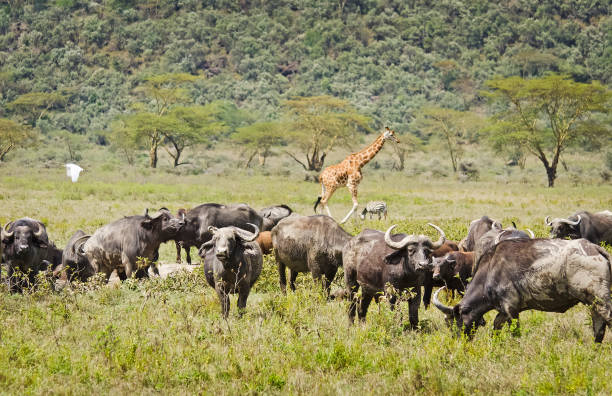
Buffaloes are abundant, forming massive herds that wallow in the mud pits during the heat of the day. Elephants are also present, though they are mostly older males. While breeding herds tend to avoid the steep crater walls, the solitary bulls, known as “tuskers,” roam the forests and swamps. The lack of large predators for calves and the difficulty of navigating the steep terrain discourage breeding herds from settling permanently.
Beyond the Crater
While most visitors focus solely on the Crater floor, the Ngorongoro Conservation Area spans 3,200 square miles (8,300 square kilometers). The landscape rises from the plains of the Serengeti to the rim of the Crater and further up into the Ngorongoro Highlands.
The Ngorongoro Highlands: As you drive from the town of Karatu up to the Crater rim, the road winds through a lush, tropical highland forest. This mist-shrouded zone is home to elephants, buffalo, leopards, and even the rare bushbuck. It is cool and often rainy, a stark contrast to the dry savannah below. The rim sits at an altitude of over 7,500 feet, offering sweeping, fog-laden views down into the caldera.
Empakaai Crater: A quieter, less visited alternative to Ngorongoro is Empakaai Crater, located about an hour’s drive northeast. Empakaai is much deeper and dominated by a deep soda lake that covers about 75% of the floor. It is a hiking paradise; walking along the rim offers spectacular views and, on a clear day, one can even see the snow-capped peaks of Mount Kilimanjaro and Mount Meru in the distance. The crater floor is a sanctuary for thousands of pink flamingos.
Oldoinyo Lengai: The “Mountain of God” in the Maasai language, Oldoinyo Lengai is an active stratovolcano located in the eastern edge of the NCA. It is the only volcano in the world that erupts natrocarbonatite lava, which is much cooler (around 510°C) than basaltic lava and appears black or white in daylight. While climbing it is arduous, it offers a spiritual experience for those who venture to its summit to view Lake Natron below.
The Cradle of Mankind: Olduvai Gorge and Laetoli
Ngorongoro is not just about wildlife; it is arguably the most important paleoanthropological site on Earth. The Olduvai Gorge, located within the boundaries of the NCA, holds the secrets of human evolution. Over the last century, excavations by the Leakey family and others have unearthed fossils of early hominids dating back nearly 2 million years, including the remains of Homo habilis and Australopithecus boisei.
Nearby, at Laetoli, footprints preserved in volcanic ash provide evidence that bipedal hominids walked here 3.6 million years ago. Visiting the small museum at Olduvai offers a humbling perspective: while you are there to watch the migration of animals, you are standing on the ground where humanity itself began its long, uncertain migration.
The Maasai People
One of the defining features of the NCA is the presence of the Maasai people. The conservation area was established in 1959 with a unique mandate: to conserve the natural resources while safeguarding the interests of the indigenous Maasai. Unlike national parks where human settlement is prohibited, the Maasai are permitted to graze their livestock in the area.
Visitors will often see Maasai warriors draped in red shuka (cloaks) herding cattle through the plains or walking along the crater rim. This coexistence is not without its challenges, conflicts between livestock and predators are common, and the pressures of population growth are constant. However, it offers a cultural dimension to a safari that is rare. Many cultural visits (or “bomas”) can be arranged where visitors can learn about Maasai customs, dances, and their symbiotic relationship with the land.
When and How to Go
Best Time to Visit The Ngorongoro Conservation Area is accessible year-round, but the experience varies by season.
Dry Season (June to October): This is the prime season. The grass is short, making wildlife spotting easier. The roads are accessible, and the skies are clear. However, the Crater can get crowded with vehicles.
Wet Season (November to May): The landscape turns lush and green, and the birdlife is spectacular as migratory birds arrive. This is the best time for birders. Calving usually occurs in January and February. The downside is that the roads to the crater floor can become incredibly muddy and slippery, requiring 4×4 capability.
Getting There Most visitors fly into Kilimanjaro International Airport (JRO) and drive to the town of Arusha. From Arusha, it is a scenic 3-4 hour drive to the entrance gate (Loduare Gate). The drive takes you through the Great Rift Valley and up the escarpment. Alternatively, charter flights can land at the airstrip near the crater rim.
The Descent into the Crater Access to the crater floor is strictly controlled. Only 4×4 vehicles are allowed, and you must be accompanied by a licensed guide. The descent gate opens at 6:00 AM, and it is highly recommended to be there early. As the day heats up, the animals tend to retreat into the shade, making morning game drives the most productive. It is important to note that there is a time limit for staying on the crater floor (usually 6 hours), which is strictly enforced by rangers.
Accommodation
The Rim: For those with a larger budget, staying on the crater rim is the ultimate experience. Lodges like the Ngorongoro Serena, and Lions Paw offer unparalleled views. Waking up to the mist clearing over the caldera is magical. It is essential to dress warmly, as the rim can be freezing at night due to the altitude.
Karatu: Located just outside the park gates, the town of Karatu offers a range of accommodation options, from luxury lodges to mid-range tented camps. It is also a great place to experience the coffee-growing culture of the region.
There is a specific moment that defines a visit to Ngorongoro. It often happens at dawn. You stand on the jagged edge of the crater, wrapped in a thick sweater, staring into a void filled with swirling white mist. Slowly, the sun burns through, revealing the floor far below, a miniature world waking up.
Descending into that caldera feels like entering a lost era. It is a place where the rules of the modern world do not apply, where the struggle for survival is tangible, and the beauty of the wild is absolute. Whether you are watching a black rhino grazing by the lake, a lioness stalking a gazelle, or a Maasai warrior herding cattle against the backdrop of the Great Rift Valley, Ngorongoro Conservation Area offers a profound connection to the earth’s ancient rhythms. It is a place that demands to be seen, respected, and remembered.