Chimpanzee trekking in Kibale Forest National Park is the major tourist activity in this park. At the apex of all chimpanzee destinations in Uganda, Kibale Forest National Park stands out. It is quite hard to determine a particular chimpanzee destination in Uganda as the best chimpanzee trekking destination. However, after exploring Kibale Forest National Park, there is very little doubt.
What is chimpanzee trekking?
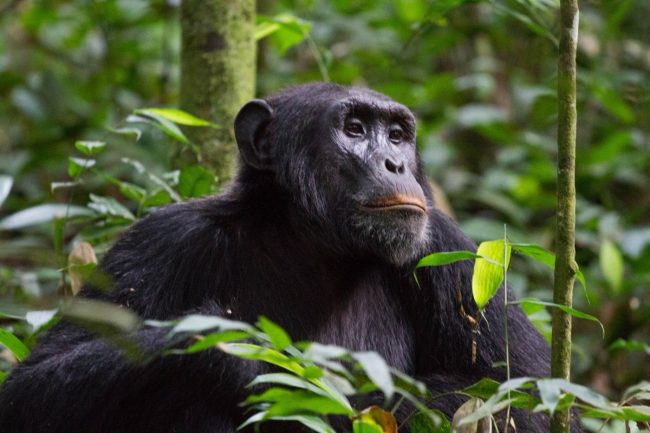
Chimpanzee trekking involves traversing the tropical rainforests and dense foliage through the uneven tracks to encounter chimpanzees for an hour. Many scholars have probably written much about chimpanzee trekking. But none tends to bring out the participatory part of it, yet it is the most important. Chimpanzee trekking is a memorable adventure that enables visitors to come face-to-face with chimpanzees.
The takeaway point here is the participation of the visitors in encountering the chimpanzees in their natural environment. Most game or wildlife viewing activities also involve visitors in a safari vehicle to see the wildlife. However, with chimpanzee trekking, the script is rewritten into an outdoor hiking/trekking adventure. This activity demands that visitors head into the tropical forests and environments that harbor these chimpanzees. All trekking is guided by an experienced team of trackers and rangers who guide the visitors to the primates.
What does the chimpanzee trekking experience entail?
Many people tend to think that the chimpanzee trekking experience starts with the process of encountering the chimpanzees. However, this leaves behind a lot of other important processes that enable the chimpanzee trekking experience to take place. The forefront of chimpanzee trekking in Kibale Forest National Park is a pre-trekking briefing.
Pre-trekking briefing
As the name suggests, a pre-trekking briefing is a session of insightful discussions that elaborate on the entire chimpanzee trekking experience. This briefing process is managed or handled by professional rangers. These highlight the specifics of trekking chimpanzees, such as the safety measures, rules and regulations, and the expected code of conduct. The aim of this pre-trekking to mentally and physically prepare the visitors for the trekking experience.
This briefing session is also informative, detailing the primate numbers in the forest and providing an overview of the habitat and experience. Safety is at the apex of this experience, and this is why visitors are also accompanied by an armed ranger. Kibale Forest National Park is a vast habitat that also harbors dangerous wildlife species like forest elephants that are aggressive but very rare to encounter.
The second step in the trekking experience is assigning visitors to a chimpanzee community. Chimpanzees live in communities headed by alpha males, and this is one of their characteristics as social beings. A particular number of visitors is assigned to a chimpanzee community. The number of chimpanzees determines the number of visitors to be assigned. However, these usually range between 6 and 8 visitors for a community of about 20 or more chimpanzees.
The trackers, in coordination with the rangers, guide visitors to the chimpanzees after a relatively long or moderate tracking period, depending on how far the primates are. At the moment of encounter and first sight of the primates, the clock ticks for an hour until the trekking process is done. Visitors can take as many pictures and videos for future memories.
What to know about Kibale Forest National Park
Kibale Forest National Park is the true reflection of chimpanzee trekking in the world. This is it earned itself the title of the primate capital of the world. Kibale is at the apex of all chimpanzee trekking destinations in the region and beyond. This is attributed to its unwavering ability to harbor over 2,000 chimpanzees. This is the largest recorded chimpanzee population in a single destination in the world. Such numbers earned Kibale a seat on the world stage by hosting numerous documentaries and films like Planet of the Apes and Chimp Empire. These recognitions further cemented Kibale as the greatest primate capital there is.
Brief history
However, before the fame, we need to go back to the brief history of Kibale and the evolution of the chimpanzee trekking experience.
Kibale Forest National Park is a protected area situated in the western region of Uganda. It stretches across 766 square kilometers, covering Kamwenge and Kabarole districts. There are smaller portions of the forest that are believed to penetrate the Kyenjojo and Kasese districts. Kibale was established as a national park in 1993 from a logged forest reserve gazetted earlier in 1932.
The park hosts over 120 mammal species that are dominated by primates, including chimpanzees, olive baboons, white and black colobus monkeys, red-tailed monkeys, blue monkeys, and grey-cheeked mangabeys, among others. Forest elephants, giant forest hogs, forest buffaloes, sitatungas, bushbucks, and African golden cats are among the many mammals here. The list widens to the bird species, with over 325 recorded here. The notable ones include the great blue turaco, masked apalis, Rwenzori apalis, Nahan’s francolin, red-faced woodland warbler, dusky crimsonwing, and black-capped apalis, among others.
The most notable activity in Kibale is chimpanzee trekking, which accounts for the high visitor turnout per year. With Uganda hosting over 5,000 chimpanzees, Kibale accounts for close to a third of the population, with 2,000 chimpanzees. All these chimpanzees are scattered across the different chimpanzee communities in the park.
Chimpanzee communities in Kibale Forest National Park
The notable communities include the Ngogo community, Kanyawara community, and Sebitoli community. The Ngogo community is the largest, hosting about 200 members at the center of the forest. It is the most popular, featuring in documentaries like the Chimp Empire. This community recently underwent a series of chimpanzee civil wars, a one-of-a-kind event that shocked the world. This changed the world’s perception of these primates. It shaped an understanding of the politics and the leadership charm of this community.
Kanyawara community lies on the extreme northwestern side of Kibale. It harbors about 50-60 chimpanzees. The chimps in this community are more reserved and easier to deal with than the Ngogo chimps. Sebitoli community is also an interesting community with over 80 members. All these communities are basically for research and conservation.
Tourism and trekking are dedicated to the Kanyantale, Buraiga, and Kisongi communities. The Kanyantale community is one of the pioneer trekking groups. Tracking chimpanzees in this community began in 1993 at the establishment of the park. There are over 90 members in this particular community. This community is situated in the Kanyanchu section of the park.
Buraiga and Kisongi communities are on the side of the Buraiga sector of the park. Although these communities are relatively newly habituated, they offer incredible chimpanzee encounters.
How much is a chimpanzee permit in Kibale National Park?
A chimpanzee permit in Kibale Forest National Park costs USD 300 for foreign non-residents, USD 200 for foreign residents, USD 100 for the rest of Africa, and UGX 180,000 for East Africans. The chimpanzee permit is obtained from the Uganda Wildlife Authority through a trusted tour operator like Epic Uganda Vacations.
A chimpanzee permit is a document that grants visitors access to Kibale to trek chimpanzees. The costs generated from the sale of permits go directly to funding the protection and conservation of the chimpanzees and their habitat. Conservation also involves the development of the communities around the park to show the benefits of these primates to the communities around. This development is through the construction of infrastructure like roads, health centers, and schools. This is a form of giving back to the community since the park is located in these local communities.
Chimpanzee trekking in Kibale is best done in the dry season, which runs from June to September and December to February. This is a time of favourable weather characterized by dry and sunny days with little or no rainfall. This eases visibility in the forest and navigation.
In conclusion, chimpanzee trekking in Kibale Forest National Park is a phenomenal experience of encountering chimpanzees for an hour in this forest. Visitors can best explore this forest for chimpanzees in the dry season. Accessibility is by both air and road networks.