Birding in Budongo Forest, Uganda: Complete Guide to Birds, Trails & Best Time to Visit
Birding in Budongo Forest is one of the most rewarding forest birdwatching experiences in Uganda. Located in western Uganda near Murchison Falls National Park, Budongo Forest is renowned for its impressive diversity of forest birds, towering mahogany trees, chimpanzees and Guinea-Congo forest species.
More than 360 bird species have been recorded in Budongo Forest, making it one of Uganda’s most important birding destinations. The forest is particularly valuable for birders searching for species associated with the Guinea-Congo biome, including several birds that are difficult to find elsewhere in East Africa.
For serious birdwatchers, the famous Royal Mile birding trail is one of the main attractions. Kaniyo Pabidi is another excellent area, particularly for birders interested in forest-floor species and the famous Puvel’s Illadopsis.
Whether you are planning a dedicated Uganda birding safari or adding a few hours of birdwatching to a Murchison Falls safari, Budongo deserves a place on your itinerary.


Where Is Budongo Forest?
Budongo Forest is located in western Uganda, south of Murchison Falls National Park and within the greater Murchison Falls conservation landscape.
The forest covers approximately 42,800 hectares and consists of different forest habitats, including mixed forest, swamp forest and areas dominated by species such as mahogany.
Its location makes Budongo particularly convenient to combine with a safari in Murchison Falls National Park.
A typical itinerary can combine:
- Budongo Forest birding
- Royal Mile birding
- Kaniyo Pabidi forest walks
- Chimpanzee tracking
- Murchison Falls game drives
- Boat safari on the Victoria Nile
- Birding around the Nile and Lake Albert Delta
This combination makes the area excellent for travelers who want to experience both forest birds and savanna wildlife in one Uganda safari.
Why Is Budongo Forest Important for Birding?
Budongo is important because it sits at an ecological crossroads where visitors can encounter both East African species and birds associated with the forests of West and Central Africa.
More than 360 species have been recorded in the forest, with numerous Guinea-Congo forest species contributing to its reputation among serious birdwatchers.
The forest also provides different habitats, allowing birders to search for species at several levels.
You may find birds:
- On the forest floor
- In the undergrowth
- In the middle canopy
- High in the mahogany canopy
- Along forest edges
- Around small streams and wet areas
- In surrounding woodland and agricultural habitats
This habitat diversity is one reason a slow, guided birding walk can produce an impressive species list.
The Royal Mile: Budongo’s Famous Birding Trail
When discussing birding in Budongo Forest, the Royal Mile is almost impossible to overlook.
The Royal Mile is a well-known forest road in the Busingiro area, running beneath impressive mature trees. It is particularly popular with birdwatchers because its relatively open character can make it easier to observe birds moving through the canopy and forest edges.
The trail is associated historically with the Bunyoro Kingdom and is now one of Uganda’s best-known forest birding locations.
A morning walk here can produce a wide variety of forest birds, particularly when undertaken with an experienced birding guide who knows the calls and preferred habitats of the different species.
Birds to Look For Along the Royal Mile
Some of the notable species reported from the Royal Mile and wider Budongo area include:
- Yellow-footed Flycatcher
- Chestnut-capped Flycatcher
- Chocolate-backed Kingfisher
- Blue-breasted Kingfisher
- African Dwarf Kingfisher
- White-thighed Hornbill
- Eastern Piping Hornbill
- Ituri Batis
- Lemon-bellied Crombec
- Rufous-crowned Eremomela
- James’s Wattle-eye
- Forest Flycatcher
- Tit Hylia
- Spotted Greenbul
- Great Blue Turaco
- Red-tailed Ant-thrush
- Grey Longbill
- Yellow-billed Barbet
- Crested Guineafowl
- Willcock’s Honeyguide
- Sabine’s Spinetail
- Cassin’s Spinetail
The exact species you encounter will depend on season, weather, time of day, habitat and the skill of your guide.
Kaniyo Pabidi Birding
Kaniyo Pabidi is another important birding area within the greater Budongo forest landscape.
It is particularly well known for chimpanzee tracking, but birdwatchers have another reason to visit: the opportunity to search for specialized forest birds.
One of the major targets is Puvel’s Illadopsis, a secretive forest bird associated with the Budongo area and a major attraction for specialist birders.
The forest floor and lower vegetation require patience because some species are much easier to hear than see.
An experienced guide can make a significant difference by recognizing:
- Bird calls
- Movement in dense vegetation
- Regular feeding areas
- Preferred forest habitats
- Roosting and nesting areas
- Species-specific behaviour
For this reason, birding Kaniyo Pabidi should not be treated simply as a walk through the forest. A specialized birding guide can turn a general forest walk into a much more productive birding experience.
Top Birds to Look For in Budongo Forest
Budongo has an impressive bird list, but some species are particularly attractive to visiting birders.
1. Puvel’s Illadopsis
Puvel’s Illadopsis is one of the major targets for birders visiting Budongo. It is a secretive forest species that can be challenging to observe without patience and a knowledgeable guide.
Its presence is one of the reasons specialist birders include Kaniyo Pabidi and Budongo in their Uganda birding itineraries.
2. Yellow-footed Flycatcher
The Yellow-footed Flycatcher is another sought-after Budongo species. It is associated with mature forest and can be difficult to locate because of its behaviour and the height of the forest canopy.
3. Chocolate-backed Kingfisher
This beautiful forest kingfisher is one of the birds that makes Budongo particularly exciting for photographers and birdwatchers.
Unlike the kingfishers many visitors associate with open water, several Budongo kingfishers are forest specialists.
4. African Dwarf Kingfisher
The tiny African Dwarf Kingfisher is another attractive species to search for during forest birding.
Its small size means that patience and good fieldcraft are important when searching through dense vegetation.
5. White-thighed Hornbill
The White-thighed Hornbill is among the larger and more conspicuous forest birds you may encounter in Budongo.
Its size and distinctive appearance make it a memorable addition to a birding checklist.
6. Ituri Batis
The Ituri Batis is one of the specialized forest birds that makes Budongo attractive to birders interested in Guinea-Congo forest species.
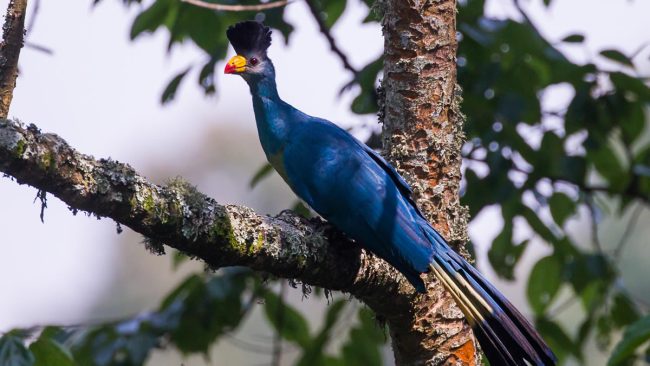
7. Great Blue Turaco
The Great Blue Turaco is another impressive bird to look for in the forest canopy.
Its large size and distinctive appearance make it easier to appreciate when compared with some of Budongo’s tiny and elusive forest species.
Best Time for Birding in Budongo Forest
Birding in Budongo Forest is possible throughout the year, but the experience can vary according to rainfall, trail conditions, bird activity and seasonal movements.
For many visitors, the drier periods can make walking conditions more comfortable. However, birding should not be restricted only to the dry season because rainfall and seasonal changes can influence forest activity and the presence of migratory birds.
Some birding operators identify periods such as February to April and June to September as productive periods, while December to February and June to August are also commonly recommended for generally easier forest conditions.
What about migratory birds?
Budongo can also be interesting during periods when Palearctic and intra-African migrants are present.
The African Pitta, for example, is reported in the area during part of the year and is a highly desirable sighting for many birders.
If your primary goal is to build a large Uganda birding checklist, it is worth discussing your target species with your safari operator before selecting your travel dates.
What Is the Best Time of Day for Birding?
The best time for birding in Budongo Forest is generally early morning.
Bird activity is often strongest during the first few hours after sunrise. This is when many forest species are feeding, calling and moving between vegetation layers.
A typical birding morning may begin before or around sunrise, followed by several hours of slow walking.
Why start early?
Early morning gives you:
- Higher bird activity
- Cooler temperatures
- Better listening conditions
- More active feeding behaviour
- Greater chances of encountering mixed-species flocks
- Better opportunities to hear elusive species
If you are serious about birding, avoid starting late simply to have a relaxed breakfast. The first hours of daylight are extremely valuable.
How Many Days Do You Need for Budongo Birding?
The amount of time you need depends on your goals.
Half day
A half-day birding excursion can work for travelers who are already visiting Murchison Falls and want an introduction to Budongo.
One full day
A full day is much better for birders who want to explore the Royal Mile at a relaxed pace and target several forest species.
Two or more days
Dedicated birders should consider spending two or more days exploring different areas such as the Royal Mile and Kaniyo Pabidi.
Spending additional time improves your chances of finding shy and less predictable species.
What to Bring for Birding in Budongo Forest
Good preparation can make your birding experience considerably more enjoyable.
Binoculars
Bring quality binoculars suitable for low-light forest conditions. An 8×42 or 10×42 pair is a practical choice for most birders.
Camera
A camera with a telephoto lens is useful because many birds will be high in the canopy or hidden within vegetation.
Field guide
Bring a good East African bird field guide or use a reliable bird identification app alongside your field guide.
Insect repellent
Budongo is a tropical forest environment, so insect repellent is recommended.
Long trousers and long sleeves
Lightweight, comfortable clothing helps protect against insects and vegetation.
Waterproof hiking shoes
Forest paths can become muddy after rain. Shoes with good grip are recommended.
Rain jacket
Weather can change quickly in tropical forests, so carrying a lightweight rain jacket is sensible.
Drinking water
Bring sufficient drinking water, especially if you are planning several hours of walking.
Why You Need a Birding Guide in Budongo
One of the biggest mistakes a first-time visitor can make is assuming that seeing birds in a rainforest is simply a matter of walking around with binoculars.
Many Budongo species are:
- Small
- Quiet
- Well camouflaged
- High in the canopy
- Hidden in dense vegetation
- Identified primarily through their calls
A knowledgeable local birding guide can recognize species before you see them and direct your attention to the correct part of the forest.
For specialist birding, this can dramatically improve the quality of your experience.
Birding and Chimpanzee Tracking in Budongo
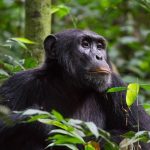
Budongo offers an excellent opportunity to combine birdwatching with primate experiences.
Chimpanzee tracking is one of the major attractions of the forest, while birding provides a completely different way of experiencing the ecosystem. Uganda’s tourism authority identifies both chimpanzee tracking and birding among the major activities in Budongo.
A well-planned itinerary could therefore include:
Morning: Birding at the Royal Mile
Afternoon: Forest walk or chimpanzee experience
Next day: Murchison Falls game drive and Nile boat safari
This creates a balanced itinerary combining birds, primates, forest and big wildlife.
Combining Budongo Forest With Murchison Falls National Park
One of the biggest advantages of Budongo is its location.
You can combine forest birding with the wildlife-rich landscapes of Murchison Falls National Park.
A birding-focused itinerary could include:
Day 1: Arrival in the Murchison Falls area
Travel to the southern or northern sector depending on your itinerary and accommodation.
Day 2: Budongo Forest Birding
Start early with birding at the Royal Mile or another suitable Budongo birding area.
Day 3: Murchison Falls Wildlife Safari
Enjoy an early morning game drive followed by an afternoon boat safari on the Victoria Nile.
Day 4: Additional Birding
Depending on your target species, explore Kaniyo Pabidi or another nearby habitat before continuing your Uganda journey.
This combination allows travelers to experience Uganda’s Guinea-Congo forest birds and savanna wildlife within the same safari region.
Budongo Forest Birding Tips for First-Time Visitors
To get the most from your experience:
- Start early. Forest birds are generally more active after sunrise.
- Move slowly. Rushing reduces your chances of finding small forest species.
- Listen carefully. Many birds are heard before they are seen.
- Use an experienced guide. Local knowledge is especially valuable for difficult species.
- Bring binoculars. Many birds occur high in the canopy.
- Be patient. Some of Budongo’s best birds are notoriously elusive.
- Carry rain protection. Tropical forest weather can change quickly.
- Allow enough time. Serious birders should consider more than one birding session.
- Combine habitats. Different trails and forest edges can produce different species.
- Keep your checklist. Recording sightings helps you compare different areas and return visits.
Is Budongo Forest Good for Bird Photography?
Yes. Budongo can be an excellent destination for bird photography, although forest photography presents challenges.
The biggest challenge is often low light beneath the forest canopy.
A fast telephoto lens, good camera settings and patience are useful.
Photographers should also avoid disturbing birds while trying to obtain closer images. A good guide can help you position yourself without unnecessarily approaching or stressing wildlife.
The Royal Mile can be particularly rewarding because some sections offer better visibility into the forest structure than denser forest trails.
Frequently Asked Questions About Birding in Budongo Forest
How many bird species are found in Budongo Forest?
More than 360 bird species have been recorded in Budongo Forest, including numerous forest specialists and Guinea-Congo biome species.
What is the best birding trail in Budongo Forest?
The Royal Mile is one of the most famous birding trails in Budongo and is a major destination for visitors searching for forest bird species.
Can I combine birding with chimpanzee tracking?
Yes. Budongo is well known for both birding and chimpanzee experiences, making it possible to combine the two activities in one itinerary.
What are the main birds to look for in Budongo?
Some of the notable targets include Puvel’s Illadopsis, Yellow-footed Flycatcher, Chocolate-backed Kingfisher, African Dwarf Kingfisher, White-thighed Hornbill, Ituri Batis, Great Blue Turaco and several other forest specialists.
How long should I spend birding in Budongo?
A half-day is possible for travelers with limited time, but one to two full days is preferable for serious birders who want to explore different habitats and search for specialist species.
Is Budongo good for beginner birdwatchers?
Yes. Budongo is suitable for both beginners and experienced birders. Beginners benefit from the diversity of birds and experienced guides, while specialist birders can focus on difficult Guinea-Congo forest species.
Plan Your Budongo Forest Birding Safari
Budongo Forest is much more than an extension of a Murchison Falls safari. For birdwatchers, it is one of Uganda’s most important forest destinations, offering the opportunity to search for rare forest specialists, colourful kingfishers, hornbills, turacos, flycatchers and Guinea-Congo biome species.
The Royal Mile, Kaniyo Pabidi and surrounding forest habitats provide different birding experiences, while the nearby Murchison Falls ecosystem allows you to combine forest birding with game drives and boat safaris.
If you are planning a Uganda birding safari, Budongo Forest deserves serious consideration—especially if your goal is to discover Uganda’s lesser-known forest birds rather than only the famous savanna species.
Looking for a tailored Uganda birding safari? Epic Uganda Vacation can help you combine Budongo Forest with Murchison Falls, Kibale, Queen Elizabeth, Bwindi, Mabamba Swamp and other important birding destinations across Uganda.