In the heart of Central Africa, nestled within the rolling highlands and deep valleys of Burundi, lies a sanctuary of staggering beauty and ecological significance. Ruvubu National Park (Parc National de la Ruvubu), established in 1982, stands as the largest protected area in the country, encompassing approximately 508 square kilometers of diverse landscapes. While Burundi is often celebrated for its idyllic coastline along Lake Tanganyika, it is the wild, untamed interior of Ruvubu that offers the most profound connection to the continent’s primordial soul. Named after the mighty Ruvubu River which forms its spine and delineates its boundary, the park is a vital refuge for some of East Africa’s most iconic species, serving as a living testament to the resilience of nature amidst the pressures of the modern world.
The Geography of Ruvubu National Park
To understand Ruvubu, one must first understand the dramatic topography that defines it. The park is situated in the eastern part of Burundi, spanning the provinces of Karuzi, Muyinga, Cankuzo, and Ruyigi. It sits within the Nile-Congo watershed, a geographical divide that shapes the hydrology of the entire region. The landscape is a breathtaking mosaic of acacia savannah, grassland plains, dense gallery forests, and massive swamps, all carved by the relentless flow of the Ruvubu River.
The river itself is the park’s defining feature. It is not merely a body of water but a dynamic force that has, over millennia, cut deep gorges and steep valleys into the surrounding hills. These altitudinal variations create a series of micro-climates that support an astonishing diversity of flora. At the lower elevations, the valley floors are lush and humid, dominated by towering palm trees and thickets of Phoenix reclinata. As the land rises, the vegetation transitions into open savannahs dotted with monumental termite mounds and interspersed with stands of the magnificent Acacia sieberiana, whose flat-topped canopies provide shade for the wildlife below.
The park’s elevation ranges from roughly 1,300 to 1,800 meters above sea level. This highland environment ensures that, despite being situated relatively close to the equator, the heat is rarely oppressive. The air is crisp, especially in the mornings and evenings, adding a refreshing quality to game drives that is distinct from the stifling humidity often found in lowland reserves. The terrain, while rugged, offers spectacular panoramic views, where the horizon is a jagged line of hills fading into the misty distance, evoking the classic imagery of the “Land of a Thousand Hills.”
A Sanctuary for the Megafauna
Ruvubu National Park was originally founded, alongside the smaller Kibira and Rusizi parks, to protect the rapidly diminishing wildlife populations of Burundi. Decades of socio-political unrest and poaching had taken a severe toll on the country’s fauna, but Ruvubu has remained a bastion of hope. Today, it boasts the largest concentration of wildlife in the country, offering visitors a chance to see species that have vanished from much of the surrounding landscape.
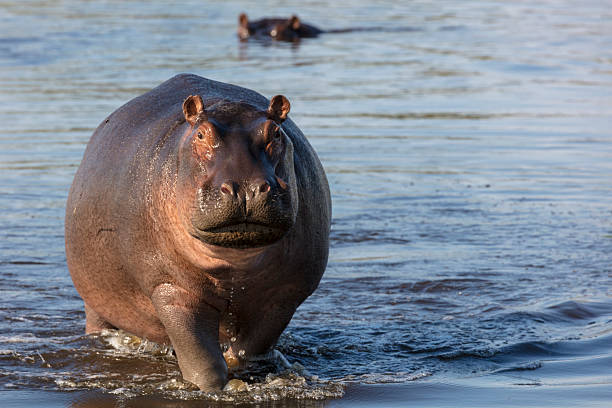
The park is perhaps best known for its significant population of hippos. The Ruvubu River, with its deep pools and calm stretches, provides the perfect habitat for these amphibious giants. Hippopotami are frequently seen wallowing in the water or resting on the sandy banks, their massive forms a testament to the river’s health. While often perceived as docile, the hippos of Ruvubu are wild and territorial, adding an element of thrill to any river crossing or boat excursion.
Alongside the hippos, the riverbanks are patrolled by Nile crocodiles, stealthy apex predators that have inhabited these waters for centuries. Seeing a crocodile basking motionless on a mudflat, its prehistoric silhouette stark against the green reeds, is a reminder of the ancient rhythms that govern this ecosystem.
Antelopes’ Home
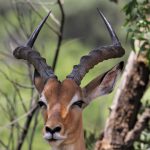
On the dry savannahs, the antelope population thrives. The most common sight is the Defassa waterbuck, a robust antelope with a shaggy brown coat and a distinctive white ring on its rump. They are often found grazing near the marshes, never straying too far from a water source. Joining them are herds of impala, renowned for their agility and impressive leaps, and the statuesque Cape buffalo. The buffalo in Ruvubu are particularly formidable, moving in large, protective herds that command respect from even the most seasoned safari guides.
While the “Big Five” are not all present here – lions and rhinos are locally extinct- the park does harbor a population of leopards. These elusive cats are the masters of stealth in Ruvubu, rarely seen but their presence is felt through the alarm calls of baboons and the occasional tracks found in the mud. Spotted hyenas also roam the park, their eerie whoops echoing through the night, serving as the soundtrack to the African wilderness.
Primate Haven and Avian Paradise
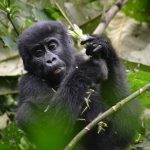
Beyond the hooves and paws of the mammals, Ruvubu is a sanctuary for primates. The gallery forests that fringe the river are home to troops of olive baboons and vervet monkeys. These intelligent, social creatures are a common sight along the park’s tracks, often interacting with vehicles or watching passersby from the safety of the trees. More significantly, the park harbors a population of chimpanzees. While they are more difficult to spot than the baboons, their distant calls booming through the forest canopy are a thrilling experience for visitors. The preservation of these chimpanzees is critical, as they represent one of the easternmost populations of the species in this part of the Rift Valley.
However, for the naturalist, it is often the avian life that truly sets Ruvubu apart. The park is a birdwatcher’s paradise, boasting over 425 recorded species. The variety of habitats – from aquatic environments to dense woodlands – supports a dizzying array of birdlife.
Water birds
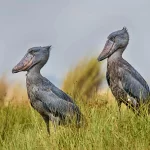
Waterbirds are particularly abundant along the river. The majestic Shoebill Stork, the “Holy Grail” for many birders, has been recorded here, though it remains a rare and elusive sighting. More common are the Great White Pelicans, various species of egrets and herons, and the striking African Fish Eagle, whose distinctive, haunting cry is synonymous with African waterways. In the savannahs, raptors such as the Bateleur Eagle and the Augur Buzzard rule the skies, scanning the grass for prey.
The gallery forests are alive with the colors of sunbirds, turacos, and hornbills. The vibrantly colored Ross’s Turaco, with its crimson flight feathers, is a particular highlight, flashing like a gem through the dense green foliage. The diversity of the birdlife in Ruvubu is not just in numbers but in the variety of ecological niches filled, making it a critical site for conservation and a delight for ornithologists.
The River of Life
The Ruvubu River is not just a geographical feature; it is the ecological artery of the park. It is a major tributary of the Kagera River, which eventually flows into Lake Victoria and contributes to the Nile River system. Consequently, the health of the Ruvubu has implications far beyond the borders of Burundi.
The river creates a linear oasis that allows animals to traverse through the dry seasons. During the dry season, the vegetation away from the river turns golden and brittle, forcing wildlife to congregate near the water. This creates a dynamic ecosystem of predator and prey, where the struggle for survival plays out daily in the open. The river also supports massive papyrus swamps, which act as natural filters, purifying the water and providing nesting grounds for birds and shelter for fish.
For the visitor, the river offers the best opportunities for wildlife viewing. Walking safaris along the banks (guided, of course, due to the presence of hippos and crocodiles) allow for an intimate experience with nature, tracking footprints in the sand and observing the smaller insects and reptiles that are often missed from a vehicle. The sound of the river rushing over rapids or gently meandering through the valley floor is a constant companion, imbuing the landscape with a sense of peace and continuity.
An Off-the-Beaten-Path Adventure
Tourism in Burundi is still in its infancy compared to neighboring Kenya or Tanzania, and Ruvubu National Park remains largely off the beaten path. For the intrepid traveler, this is its greatest appeal. A visit to Ruvubu is not about ticking off a checklist of animals in a crowded safari vehicle; it is about immersing oneself in a truly wild landscape.
The infrastructure within the park is basic. There are few luxury lodges; instead, accommodation often consists of camping or staying in simple guesthouses in the nearby towns. This requires a spirit of adventure and a willingness to forgo modern comforts for the sake of authenticity. The rewards, however, are immense. Imagine watching a sunset over the Ruvubu valley with no other vehicles in sight, the only sounds being the wind in the grass and the distant roar of a hippo.
The primary activity in the park is game driving. The network of tracks covers the main habitats, allowing visitors to explore the savannah and the riverine forests. Guided walking safaris are increasingly available and offer a different perspective, focusing on the flora, the smaller fauna, and tracking techniques. Bird watching tours are also gaining popularity, attracting enthusiasts eager to spot rare species endemic to the Albertine Rift.
Accessibility to the park has improved in recent years. While a 4×4 vehicle is essential, particularly during the rainy season when roads become muddy quagmires, the park is relatively accessible from the capital, Bujumbura. The drive itself is an experience, taking travelers through the patchwork of hills and villages that characterize the Burundian countryside, offering a glimpse into the daily lives of the local people.
Conclusion
Ruvubu National Park is more than just a tourist destination; it is a symbol of Burundi’s natural heritage. It represents the potential for balance between conservation and development, and the possibility of recovery even after profound trauma. It is a place where the wild heart of Africa still beats strong, largely undisturbed by the trappings of mass tourism.
As the world becomes increasingly urbanized and disconnected from the natural world, places like Ruvubu become sanctuaries not only for wildlife but for the human spirit. They remind us of our place in the natural order and the importance of preserving the planet’s biodiversity.
For those willing to make the journey, Ruvubu offers a rare gift. The chance to explore an African wilderness that feels raw, real, and undiscovered. It is a landscape of dramatic contrasts populated by animals that fight for survival every day. It is a place that leaves an indelible mark on the memory, a vivid tableau of the beauty and fragility of our world. In protecting Ruvubu, Burundi is protecting a vital piece of the planet’s lungs, a haven for life that deserves to be recognized, celebrated, and preserved for generations to come.