Calving Seasons in the Serengeti and Masai Mara. When the word “safari” crosses a traveler’s mind, the imagination often conjures dust-choked air, the thunder of hooves, and the perilous leap of a wildebeest across a crocodile-infested river. The Great Migration is famous for its drama, specifically the river crossings in the Northern Serengeti and Masai Mara from July to October. However, for the true connoisseur of African wildlife, there is a different, equally mesmerising, and arguably more emotional season that often goes overlooked by the casual tourist: the Calving Season.
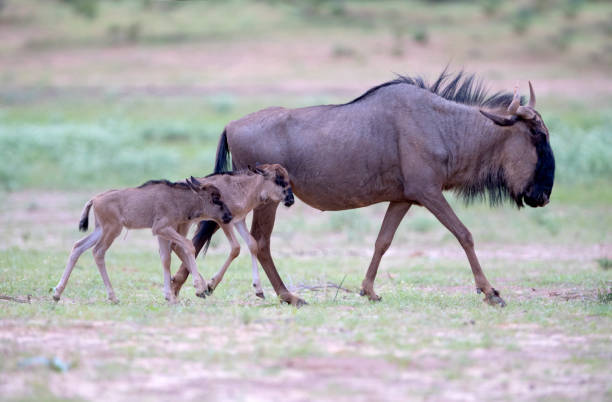
This is the time when the endless plains are transformed into a massive nursery. It is a season of vulnerability, ferocious predator action, and the miraculous first steps of thousands of newborns. Understanding the differences between the calving seasons in the Serengeti (Tanzania) and the Masai Mara (Kenya) is key to unlocking a unique dimension of the East African safari.
The Serengeti Calving Season
The undisputed capital of the calving world is the Southern Serengeti, specifically the Ndutu region (spanning the Ngorongoro Conservation Area and the Serengeti proper). This is the setting for the first act of the Great Migration’s annual cycle.
When and Where
The season begins in January, peaks in February, and tapers off in March. During these months, nearly two million wildebeest, zebras, and gazelles congregate on the short-grass plains of the South. The Ndutu plains are geologically unique, sitting on volcanic soil rich in minerals like calcium and phosphorus. This grass is not only abundant but highly nutritious, essential for lactating mothers.
The Scale of Life
The statistics are staggering. In a peak window of just three to four weeks, approximately 8,000 wildebeest are born every single day. By the end of the season, nearly half a million calves join the herd.
The synchronisation of this event is an evolutionary survival strategy known as “predator swamping.” By giving birth simultaneously, the herd overwhelms the predators. There is simply too much food for the lions, hyenas, and cheetahs to consume. Even if a predator kills a calf every few minutes, the sheer number of newborns ensures the survival of the species.
The Visitor Experience
For the photographer and wildlife enthusiast, this is paradise. Unlike the dry season when the landscape is dusty and brown, the Southern Serengeti during the calving season is lush and green. The skies are dramatic, often filled with towering cumulus clouds that provide the perfect backdrop for photography.
The action is intimate
Because the herds are concentrated in a specific area to give birth, you do not have to search for them. The game driving is often stationary; you simply park near a herd and watch the drama unfold. You will witness the brutality of nature almost immediately. Within minutes of birth, the calf is up and running. If not, it becomes a target. This season offers the highest concentration of predator action in Africa. It is not uncommon to see multiple hyenas or lions hunting in the daylight, taking advantage of the vulnerable young. It is visceral, sometimes heartbreaking, but undeniably real.
The Masai Mara Calving Season
While the Serengeti hosts the bulk of the migration’s birthing, the Masai Mara has its own distinct calving season that is often neglected by itineraries focused solely on the August river crossings.
When and Where
The Masai Mara calving season corresponds with the “short rains” that fall in October, November, and December. During this period, the main migration herds are usually arriving or departing, crossing back and forth from the Serengeti. However, the true calving highlight in the Mara involves the resident herds and the “Loita” migration.
Many travelers are unaware of the Loita wildebeest population. These are distinct from the main Serengeti herds. They migrate from the Loita Plains to the east of the Mara into the reserve during the dry season and calve here during the short rains of November and December.
The Visitor Experience
If you visit the Masai Mara in November or December, you are rewarded with a completely different landscape than the dry, golden savanna of summer. The reserve turns into a vibrant emerald green. The air is crisp and free of dust, and the birdlife is phenomenal as migratory birds arrive from Europe and Asia.
The calving here is more dispersed than in Ndutu. You won’t see 8,000 births in a single field, but you will find pockets of intensive activity across the reserve. The resident wildebeest, topi, and impala all give birth during this time. This creates a “mini-migration” atmosphere but with a fraction of the tourist vehicles found in August.
The advantage of the Mara during this season is the diversity of wildlife interactions. Because the grass is longer than in the short-grass plains of Ndutu, the cheetah sightings are spectacular. Cheetahs use the termite mounds and slight elevations to scan for prey, and the abundance of young gazelles makes for frequent, high-speed chases.
Comparing the Two: Ndutu vs. The Mara
While both events involve the birth of hoofed mammals and a spike in predator activity, the atmosphere differs significantly.
The Herd Size: The Serengeti (Ndutu) offers the sheer scale of the mega-herd. It is a horizon-to-horizon experience of black dots moving across the plain. It feels overwhelming and ancient. The Masai Mara offers a more intimate experience. You see the births interspersed with the other resident game, elephants, giraffes, and the massive herds of buffalo that are permanent residents of the Mara.
The Landscape: Ndutu is characterised by vast, open, treeless plains. This offers unobstructed viewing but feels somewhat exposed. The Masai Mara in November is dotted with flat-topped acacia trees and rolling hills. The scenery is arguably more varied and classically “African movie” style.
The Crowds: The Southern Serengeti has become increasingly popular in February. While the area is vast, certain hotspots around Ndutu can get crowded with safari vehicles all jockeying for a position during a predator kill. The Masai Mara in November and December is traditionally the “low season.” Lodges offer lower rates, and you can often have a sighting entirely to yourself, providing a much more private and exclusive feel.
The Predator Dynamics
In both locations, the influx of vulnerable young triggers a behavioural shift in the predators. This is the best time of year to see the full spectrum of the food chain in action.
In the Serengeti, the hyena is the king of the calving season. While lions get the glory, hyenas are the primary predators of wildebeest calves. The clans are massive, sometimes numbering up to 80 individuals. Watching the strategic coordination of a hyena clan hunting on the open plains is a masterclass in cooperation.
In the Masai Mara, the dynamic is slightly different due to the terrain. The cheetah population thrives during the calving season because the tall grass of the rainy season allows them to stalk effectively, while the newborn gazelles provide easy targets. Furthermore, the large resident lion prides in the Mara, such as the famous Marsh Pride or the Paradise Pride, take full advantage of the easy meals. It is a time of plenty, meaning you are more likely to see cubs of the predators themselves, as the abundance of food ensures higher survival rates for lion and cheetah cubs born earlier in the year.
Practical Considerations for the Traveller
If you are planning to visit during calving season, there are logistical differences to consider.
Serengeti (Ndutu): To access the best calving grounds, you need to stay in the Ndutu area. Permanent tented lodges like Ndutu Safari Lodge are legendary, but many operators set up semi-permanent luxury tented camps specifically for the season (January to March). Driving from Central Serengeti or Karatu to Ndutu takes about 1.5 to 2 hours, but staying inside the Ndutu area allows you to be out at first light, which is when the predator action is hottest.
Masai Mara: In November and December, you can stay in the main reserve conservancies (like Mara North or Naboisho) or inside the reserve itself. The conservancies offer the added benefit of night drives, which are not permitted inside the main park. Night drives during calving season are particularly rewarding, as this is when the predators are most active.
Be prepared for rain. The “Short Rains” in November and the “Long Rains” in March/April can make the grassy plains muddy. A good 4×4 vehicle is essential, and high-quality rain gear is a must. However, the rain usually comes in short, dramatic bursts, clearing the air and leaving the colours saturated and vivid.
Why Choose Calving Season?
The river crossings are adrenaline-fueled and chaotic, but the calving season is emotional. It is a celebration of new life amidst the constant presence of death. It offers a quieter, greener, and more lush safari experience compared to the dry, dusty peak season.
Choosing between the Serengeti and the Masai Mara for calving season depends on what you value most. If you want to witness the sheer magnitude of the migration, then the Southern Serengeti in February is your destination. It is the grand theatre of nature.
If you prefer a more diverse landscape, the chance to see the “Loita” herds, and a quieter experience with incredible green scenery and fewer vehicles, then the Masai Mara in November or December is the perfect choice.
Either way, you will leave with a profound respect for the resilience of the wildebeest and the intricate, unforgiving, yet beautiful balance of the African wild. You will see the circle of life not as a cliché from a movie, but as a tangible, breathing reality playing out before your eyes.