The Great Migration Explained: Serengeti’s Greatest Wildlife Event. There is perhaps no single event on the planet that captures the raw, unbridled power of nature quite like the Great Migration. It is a phenomenon so vast in scale and so primal in its execution that it defies simple description. It has been called the “Greatest Show on Earth,” the “World Cup of Wildlife,” and the “last great migration.” To witness it is to witness the very heartbeat of the African savannah, a relentless, rhythmic pulse of life, death, and rebirth that has played out across the plains of East Africa for millennia.
While the term “migration” suggests a simple journey from point A to point B, the reality is far more complex. The Great Migration is a continuous, circular cycle driven by the ancient instincts of millions of animals. It is a never-ending pursuit of food and water, dictated not by a calendar, but by the whims of the weather. It is the eternal struggle between the predator and the prey, and the resilience of the herbivore against the harsh elements.
A Moving Army
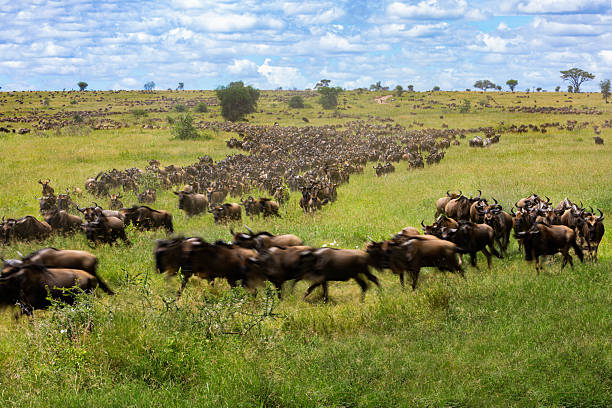
The migration is not a solitary endeavor. It is a mega-herd comprised primarily of 1.5 to 2 million blue wildebeest (also known as gnus). Accompanying them are roughly 200,000 to 300,000 plains zebras and 400,000 Thomson’s and Grant’s gazelles.
This ungainly alliance is a fascinating study in symbiotic behavior. The wildebeest are bulk grazers, preferring the short, nutritious grasses found on the plains. They act as the “lawnmowers” of the Serengeti, cropping the grass to a height that the zebras find palatable. The zebras, in turn, have a more robust digestive system capable of processing the tougher, longer grasses. Furthermore, zebras possess superior eyesight and hearing; they act as the sentinels for the wildebeest, alerting the herd to danger. The gazelles, nimble and quick, exploit the gaps, feeding on the smallest shoots of new growth. Together, this massive biological engine consumes thousands of tons of vegetation every day, fertilizing the soil with their dung as they move.
The Engine of the Movement: Rain and Grass
To understand the migration, one must understand the trigger. The animals do not migrate for the sake of moving; they migrate to survive. The driving force is the seasonal rains. The Serengeti ecosystem lies in a transition zone between the tropical rainforest of the Congo and the arid desert of the Sahara. This creates a distinct wet season and a dry season. The wildebeest follow the rain clouds, which in turn grow the grass. It is a never-ending, clockwise loop across the Serengeti National Park in Tanzania and the Maasai Mara National Reserve in Kenya.
The route is not a straight line but a circuit of roughly 1,800 to 2,000 miles (3,000 km) per year. The speed of the movement varies from a slow grazing drift to a frantic stampede, averaging about 30 miles a day.
Phase 1: The Southern Calving (December – March)
As the short rains begin to fall in November and December, the migration herds make their way to the rich, volcanic plains of the Southern Serengeti and the Ndutu region of the Ngorongoro Conservation Area. The soil here is rich in minerals like calcium and phosphorus, essential for the nursing females and the growth of young.
This is the season of birth. Between January and March, roughly 8,000 wildebeest calves are born every single day. Within minutes of hitting the ground, these calves are on their feet. This synchronized birthing strategy is an evolutionary masterpiece. By overwhelming the predators with sheer numbers, the herd ensures that a sufficient percentage of the calves will survive. Predators are indeed present, lions, cheetahs, hyenas, and leopards gather for a feast, but the sheer volume of prey means that for every calf taken, many more survive to continue the journey.
For the observer, this is the most magical time. The plains are lush and green, filled with the sounds of new life. It is chaotic, heartwarming, and heartbreaking all at once.
Phase 2: The Grumeti River and Western Corridor (May – July)
As the long rains end in April and May, the southern plains begin to dry out. The grass turns from emerald to gold, and water holes evaporate. The herds gather into massive columns and begin their march north-west.
This movement involves navigating the Western Corridor, a region of hilly woodland and riverine forests. Here, the herds face their first major obstacle: the Grumeti River. While less famous than the crossings in the north, the Grumeti is formidable. It is home to some of the largest Nile crocodiles in Africa, massive reptiles that have been gorging themselves on the migration for decades.
During this period, the tension is palpable. The herd is in prime physical condition after the lush southern grazing, but the threat of the crocodiles adds an element of danger. The crossing here can be chaotic. Unlike the later river crossings where the banks are steep and muddy, the Grumeti crossings are often less frantic but no less dramatic. The herds spread out in long lines, sometimes taking hours to cross the swollen waters.
Phase 3: The Mara River Crossings (July – October)
This is the climax of the migration, the scene that has been immortalized in countless nature documentaries. The herds have moved north, spreading out across the Northern Serengeti. Here, they encounter their greatest barrier: the Mara River. Beyond it lie the lush green pastures of the Maasai Mara in Kenya.
The Mara River crossings are unpredictable. It is not a single event that happens once a year; it happens repeatedly over a period of weeks or months. The herds will gather on the southern bank, sometimes pacing, sometimes waiting for hours or days. The decision to cross is often sparked by a “crazed” individual who plunges in, triggering a stampede behind it.
The river is deadly. The banks are often steep and muddy, making it difficult for the animals to climb out on the other side. The currents are strong, and the water is deep. And waiting below the surface are the Nile crocodiles.
Watching a crossing is an assault on the senses. The noise is deafening, the grunting of thousands of wildebeest and the crashing of hooves. The dust rises in clouds. The water churns white with foam and turns red with blood. It is a spectacle of raw violence. Many animals drown or break legs in the crush. The crocodiles seize their moment. Yet, the urge to find food overrides the fear. They push forward, scrambling up the muddy banks on the far side to safety. It is estimated that roughly 250,000 wildebeest die during the migration, not just from predators, but from injury, exhaustion, and drowning. However, the population remains stable due to the high number of calves born in the south.
Phase 4: The Long Trek South (October – December)
By October, the rains have usually returned to the south, and the grass in the Maasai Mara has been grazed down. The vast herds, now battle-worn and weary, turn their heads southward once again.
This leg of the journey is less celebrated by tourists but arguably the most arduous for the animals. Instead of a concentrated front, the herds often disperse into smaller groups as they spread across the plains, moving in a broad front that covers miles. They face the constant threat of the resident predators of the northern and central Serengeti. The males are also in rut during this time, fighting aggressively for dominance and mating rights. The air is filled with the sounds of clashing horns and grunting challenges.
As they reach the plains of the south in November, the cycle is complete. The grass is lush again, and the females are heavily pregnant, ready to drop their calves in the safety of the calving grounds.
Predators and Scavengers
The migration is not just about the herbivores; it is the lifeblood of the Serengeti’s predator population. The resident predators are hyper-alert during the migration. The abundance of food means lions have more energy to hunt, and their cubs have a higher survival rate. Leopard sightings increase. Hyenas, often maligned as scavengers but actually highly effective hunters, thrive.
But the migration also supports the clean-up crew. Vultures circle high above, waiting for a kill. Jackals and jackals patrol the periphery. Beetles and termites break down the waste. The migration is a massive transfer of energy from the soil to the plants, to the grazers, to the predators, and back to the soil. It is the perfect circle of life.
To witness the Great Migration is to understand the true meaning of the wild. It is chaotic, cruel, violent, and beautiful. It is the earth’s greatest drama, playing out on an endless stage. And if you are lucky enough to find yourself in the dust of that stampede, listening to the thunder of a million hooves, you will carry a piece of that ancient rhythm with you forever.