The Best Time to Visit Serengeti for Calving Season (Jan–March Guide): When travelers dream of the Serengeti, their imagination usually fixates on the drama of the dry season: the thunderous hooves of river crossings in the north and the dust-choked plains of the center. However, for the safari connoisseur, the true magic of the ecosystem reveals itself during the “Green Season.” From January to March, the vast plains of the Southern Serengeti undergo a transformation that is both serene and incredibly intense.
This period marks the Calving Season, the Great Migration’s best-kept secret. It is a time when the horizon is filled with the wobbling legs of newborns, the air is thick with the scent of rain and wildflowers, and the circle of life plays out in its most unfiltered form. If you are considering a journey to Tanzania during the first quarter of the year, here is a comprehensive guide on what to expect and why it might just be the best decision you make.
What is Calving Season?
To understand the draw of January, February, and March, one must understand the rhythm of the Great Migration. The movement of nearly two million wildebeest, zebras, and gazelles is a constant, year-round search for grazing and water.
Following the “short rains” of November and December, the southern plains of the Serengeti (specifically the Ndutu region and the Ngorongoro Conservation Area) erupt with lush, nutrient-rich grass. This grass is not just abundant; it is packed with the calcium and phosphorus needed for lactating mothers. Drawn by this super-food, the herds congregate in the south to give birth.
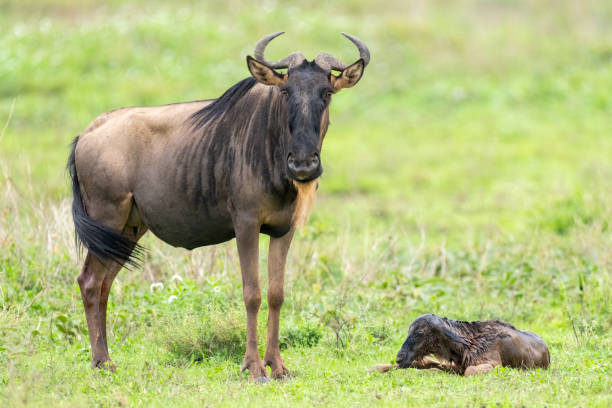
The synchronization of this event is an evolutionary masterpiece. Over a period of three to four weeks, roughly 8,000 wildebeest are born every single day. By the end of the season, nearly half a million calves join the herd.
This phenomenon is known as “predator swamping.” By giving birth simultaneously, the herd overwhelms the predators. There are simply more calves than the predators can possibly eat. While the mortality rate is high, the sheer volume ensures the survival of the species. For the visitor, this means front-row seats to the most prolific wildlife viewing on the planet.
Month-by-Month Breakdown: What to Expect
While the general window is January through March, the atmosphere shifts slightly each month.
January: The Arrival
As the new year begins, the herds are in full motion, moving from the central plains toward the deep south. The landscape is a vibrant, electric green. This is a transitional month where the plains fill up rapidly. You will see the beginning of the births, but the main event is still ramping up. The weather is generally warm and pleasant, with afternoon showers that clear up quickly, leaving fresh air and dramatic sunsets.
February: The Peak
February is undoubtedly the best month for calving season. This is the heart of the action. The herds are concentrated tightly around the Ndutu area and the southern Serengeti plains. The sheer density of animals is mind-boggling. It is during this month that the majority of the births occur. The plains are dotted with young calves, some only minutes old. For a photographer, this month offers the contrast of the deep green grass, dark storm clouds, and the black-and-white stripes of the zebras against a landscape teeming with life.
March: The Transition
As March progresses, the calves are gaining strength, and the herds begin to prepare for the long journey north. The rains can be heavier in March, making the roads muddy but the scenery even more lush. The animals are still present, but they start to spread out a bit more, grazing voraciously to build up fat reserves for the months ahead. Towards the end of March, the “long rains” begin, signaling to the herds that it is time to start moving toward the Western Corridor.
Wildlife Dynamics
While the sight of a newborn wildebeest taking its first steps is heartwarming, the calving season is famous for another reason: predator action.
This is the time of plenty for the carnivores of the Serengeti. The abundance of vulnerable, slow-moving calves attracts predators from all over the ecosystem. This is arguably the best time of year to see lions, leopards, cheetahs, and hyenas in action.
- The Hyena Clans: While lions are often seen as the kings of the savanna, during calving season, the spotted hyena is the dominant predator. Hyenas are efficient hunters, and with large clans numbering up to 50 individuals, they capitalize on the confusion of the birthing herds.
- The Cheetahs: The southern plains are open and lack the dense thickets found in the north, making it the perfect habitat for cheetahs. You will often see mothers with cubs during this time, as the easy availability of food ensures higher survival rates for their young.
- The Big Cats: Lions are everywhere. Because the grass is shorter (due to the grazing of millions of herbivores), spotting lions is much easier than in the tall grass of the dry season. You will often see them hunting in broad daylight, utilizing the kopjes (rocky outcrops) as vantage points.
It is important to note that during this season, nature is visceral. You are likely to witness kills. It can be heartbreaking to watch a young calf taken by a predator, but it is a profound educational experience that highlights the harsh reality of the African wild.
The Landscape and Weather
One of the most compelling reasons to visit between January and March is the transformation of the landscape. The dusty, golden hues of the dry season are replaced by a vibrant, emerald green.
Wildflowers: The plains bloom with wildflowers, adding splashes of yellow, white, and purple to the foreground of your photos.
Skyscapes: The “Green Season” is famous for its dramatic skies. towering cumulonimbus clouds build up during the day, creating a moody, atmospheric backdrop that makes for stunning photography. The light is softer and less harsh than the midday sun of the dry season.
Temperature: It can be deceptive. While the days are warm and pleasant (25°C – 28°C), the mornings and nights can be surprisingly cold, dropping to near freezing due to the altitude. Being in an open vehicle at 6:00 AM can be a chilly experience, so layers are essential.
Regarding the rain: Don’t let the threat of rain deter you. Rainfall usually occurs in the form of short, intense tropical showers in the late afternoon. It rarely rains all day. The rain settles the dust and cools the air, often resulting in clearer animal activity immediately following the shower.
Practical Tips for the Traveler
If you decide to embark on a Calving Season safari, preparation is key.
Pack Layers: Bring a warm fleece or jacket for morning game drives. It starts cold, heats up by midday, and cools down again in the evening.
Waterproof Gear: A good poncho or rain jacket is essential, along with a dry bag for your camera equipment. The rain can come suddenly.
Choose the Right Base: To be close to the action, stay in the Southern Serengeti or Ndutu area. Long-established lodges like Ndutu Safari Lodge or luxury mobile camps like Serengeti Under Canvas or Ndutu Kati Kati place you right in the middle of the nursery. Avoid staying in the Central Serengeti (Seronera), as it is a 1.5 to 2-hour drive to the calving grounds.
Book Early: Despite being the “low season,” the best camps in Ndutu fill up quickly because serious safari enthusiasts know this is the prime time for photography.
Conclusion
Visiting the Serengeti between January and March is not just about seeing animals; it is about understanding the ecosystem. It is a time of renewal and sacrifice. It offers a quieter, greener, and more profound safari experience than the high-energy drama of the river crossings.
If you are willing to embrace a bit of mud and the possibility of a shower, you will be rewarded with one of the most spectacular wildlife displays on Earth. Watching a newborn calf stand on shaky legs mere minutes after birth, while a lioness watches from the shadows, is a reminder of the resilience of nature. The Calving Season is the Serengeti at its most alive, a vibrant, loud, and beautiful affirmation of life.