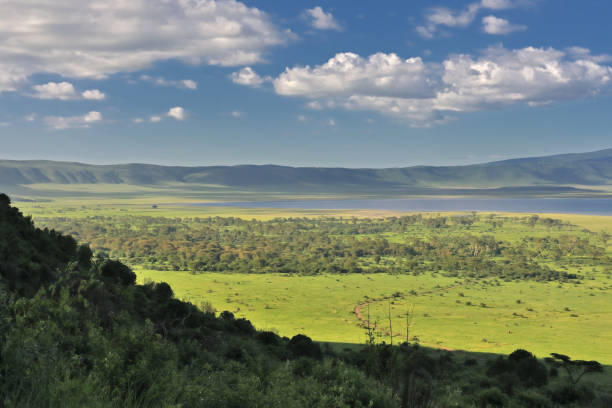
If you’re planning a safari, you’ve probably seen Ngorongoro Crater described as “the Eighth Wonder of the World,” “a natural amphitheater,” or “the Serengeti in a bowl.” But what makes people actually book? Not just the superlatives, the origin story.
Understanding how Ngorongoro Crater was formed turns a destination into an experience. It gives your safari meaning. It helps travellers imagine the landscape evolving over millions of years, and it makes every wildlife sighting feel more dramatic. In other words: geology is the hook, and wildlife is the payoff.
Ngorongoro Was Born from a Volcanic Collapse
Ngorongoro Crater didn’t start as a crater. It began as a massive volcanic system, an ancient volcano that once dominated the region.
Over time, volcanic activity shaped the landscape, and the volcano’s structure then became unstable. Eventually, instead of erupting into an endless chain of lava flows, the volcano collapsed. That collapse created a vast caldera, essentially a huge bowl formed when the land sinks inward after the top of a volcanic chamber loses support. This caldera later became something far more valuable than rock and ash: a naturally enclosed ecosystem.
And that’s why people come. Not just to visit a famous place, but to step into a living museum of volcanic history, where the geology quietly funnels wildlife into view.
Step 1: An Ancient Volcano Built the Foundation
Long before Ngorongoro became a crater, the area was shaped by volcanic forces. The region around present-day Ngorongoro sits along tectonic activity connected to the East African Rift System. That rifting created pathways for magma to rise, fueling repeated volcanic episodes.
Imagine a landscape that today would be unrecognizable: steep volcanic slopes, shifting lava layers, and a mountain-scale volcanic cone towering above the plains. For travelers, this matters because it explains something you’ll see immediately from the rim: Ngorongoro doesn’t feel like an ordinary valley. It feels engineered by nature.
Volcanoes build mass. They create elevation and structure. The first phase of Ngorongoro’s story is about construction, the region was being built up, layer by layer.
Step 2: The Volcanic Peak Lost Its Support
A volcano’s stability depends on pressure, magma supply, and the structural integrity of its volcanic plumbing. When volcanic activity changes, or when magma chambers empty, there’s a turning point.
In Ngorongoro’s case, the volcanic system experienced conditions that eventually led to a dramatic collapse. When the top portion no longer had the same support beneath it, the structure began to weaken. This collapse is the pivotal moment. It’s also the part that makes Ngorongoro feel so different from other crater-like landscapes. Many volcanic depressions are formed by explosion and ejection; Ngorongoro’s formation story centers on the caldera collapse, where the summit region gives way and sinks.
Step 3: Caldera Collapse Created a Massive “Natural Amphitheater”
Once the volcano’s upper structure collapsed, a huge depression formed. Over time, this became what we recognize as Ngorongoro Crater, a giant caldera that functions like a natural amphitheater.
Step 4: Time Then Did the Rest, Water, Sediment, and Ecology
A crater alone isn’t a world-class destination. It needs life. After the collapse, sedimentation and erosion gradually altered the caldera’s interior.
Rainwater collected in the basin. Seasonal streams and changes in drainage helped shape vegetation. Over countless years, the crater became a stable ecosystem where grasses could grow, predators could hunt, and prey could graze.
Why the Formation Story Makes Wildlife Sightings Feel More Special
If you want to boost conversion rates, connect formation to outcomes. Here’s how Ngorongoro’s volcanic origin ties directly to the experience people pay for.
Concentration Effects
Because of the crater’s enclosed shape and internal habitat variety, animals often remain within the basin when conditions are favorable. That can lead to high rates of sightings on a single day.
Predictable Landscapes for Guides
Guides benefit from clear terrain structure. When the environment is naturally compartmentalized, it becomes easier to plan drives, understand animal movement patterns, and create a smoother safari itinerary.
Photo-Worthy Dramatic Geography
Travelers don’t just want animals; they want images that communicate “I was there.” Ngorongoro’s walls create dramatic backdrops, and the contrast between rim views and crater floors elevates the visual payoff.
What Travelers Should Expect on an Ngorongoro Safari
Now let’s translate formation into a compelling, booking-ready itinerary concept.
Start on the Rim: Many safaris include an early viewpoint from the rim. This is your chance to tell the formation story in a way that travelers can feel.
Descend: See the Ecosystem Created by Collapse: As you drive into the crater floor, the change is immediate, vegetation shifts, temperatures often feel different, and the animal landscape becomes more tangible.
Spend the Middle Hours Watching the Story Unfold: Most safari days revolve around prime viewing hours: when animals are active and the light helps both spotting and photography.
Ngorongoro isn’t just a wildlife destination, it’s a living result of volcanic collapse.
Millions of years ago, the Earth created a natural amphitheater. Over time, it filled with grasses, water, and predators and prey, turning catastrophe into an ecosystem that invites extraordinary sightings. This transforms your offer into something memorable. It also helps travelers justify the cost and the travel effort. They’re not buying a drive; they’re buying meaning plus experience.
Ngorongoro Crater formed through volcanic activity followed by a massive caldera collapse. After the ancient volcano’s summit structure destabilized and sank, a vast natural bowl was created. Over millions of years, erosion, sedimentation, and rainfall shaped the crater’s interior into a stable ecosystem supporting diverse habitats. Today, that bowl-like geography helps concentrate wildlife and creates exceptional opportunities for sightings, photography, and immersive storytelling, making Ngorongoro one of Africa’s most unforgettable safari destinations.